REFLECTION : abaca fibre

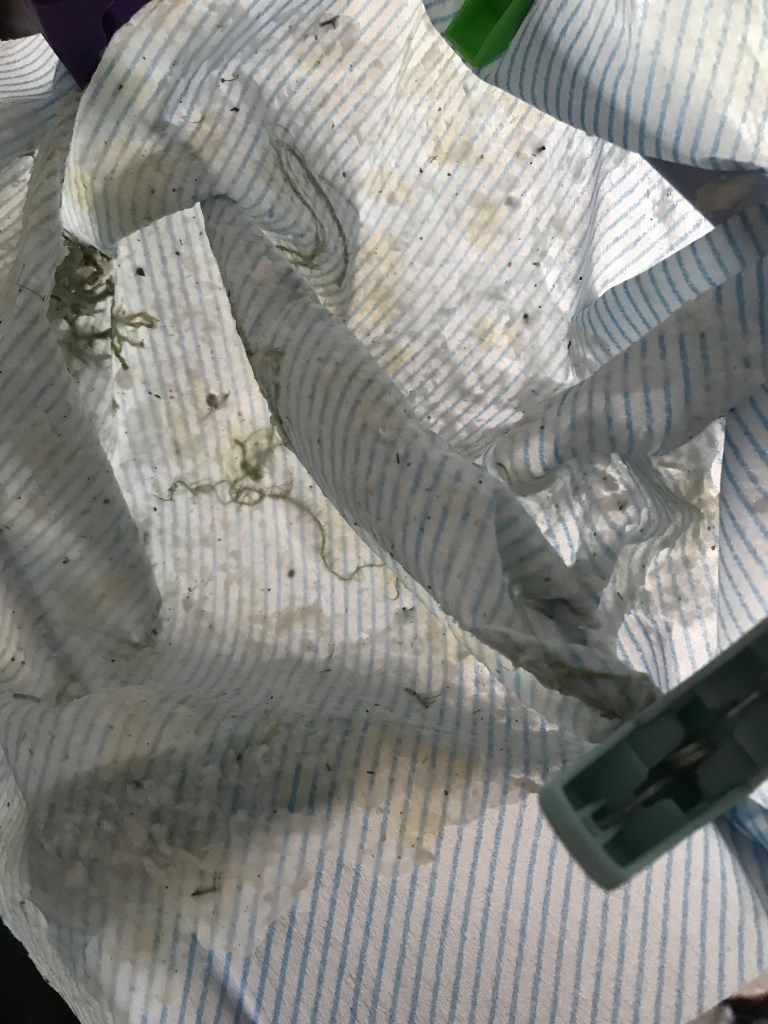
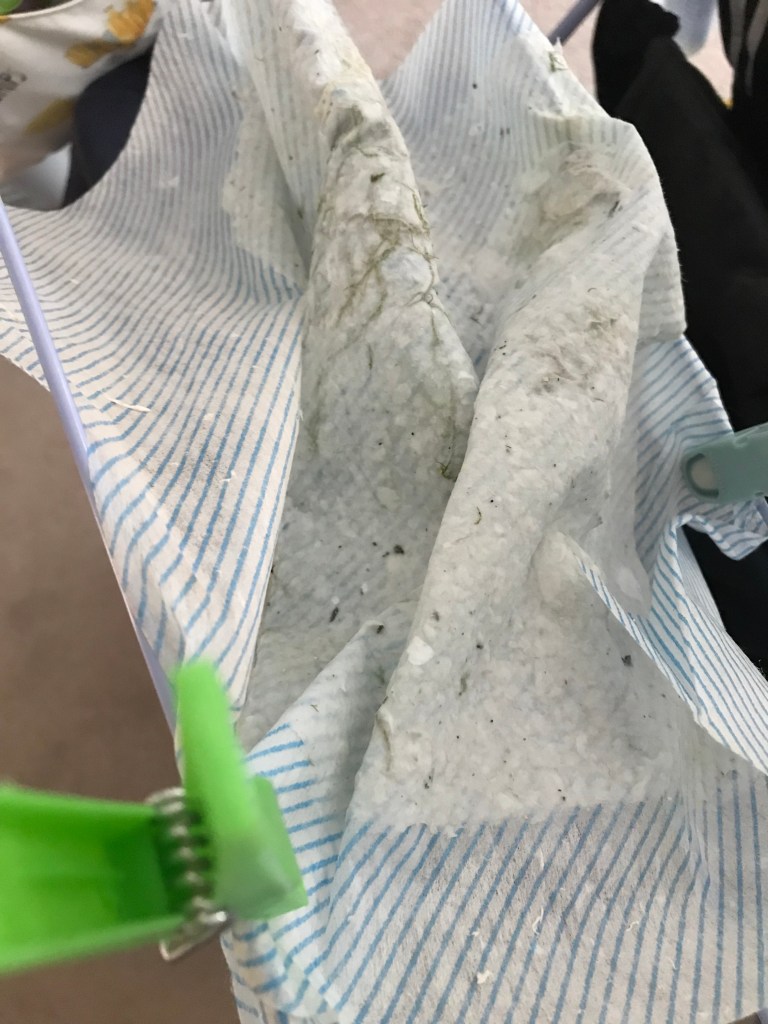
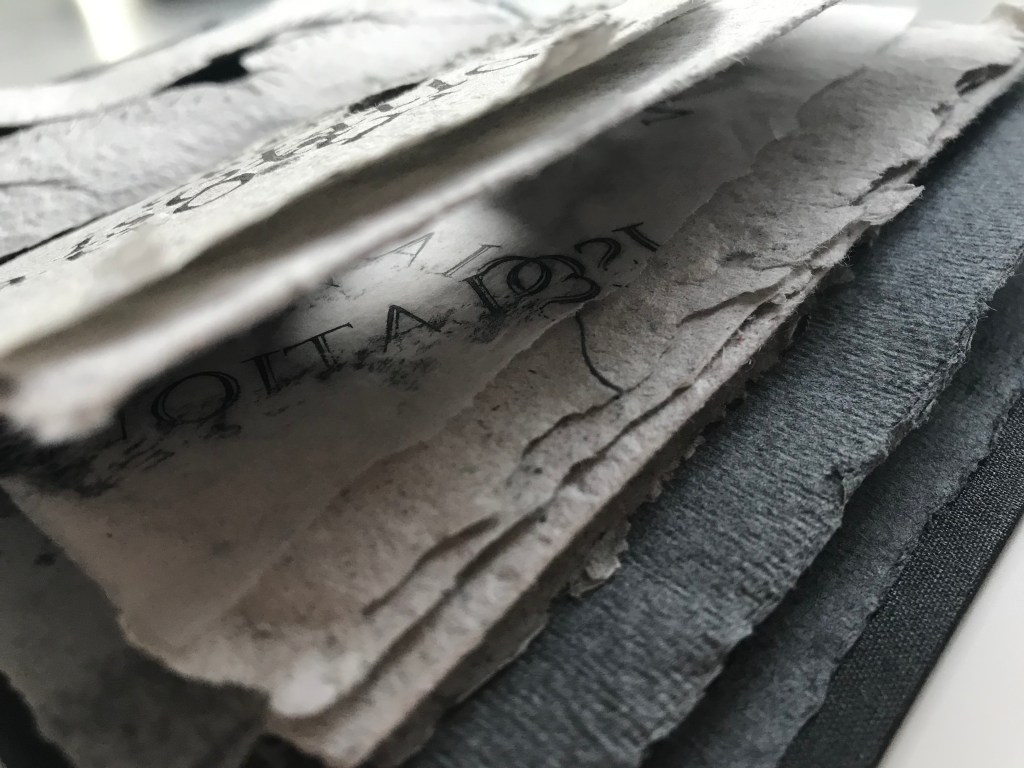
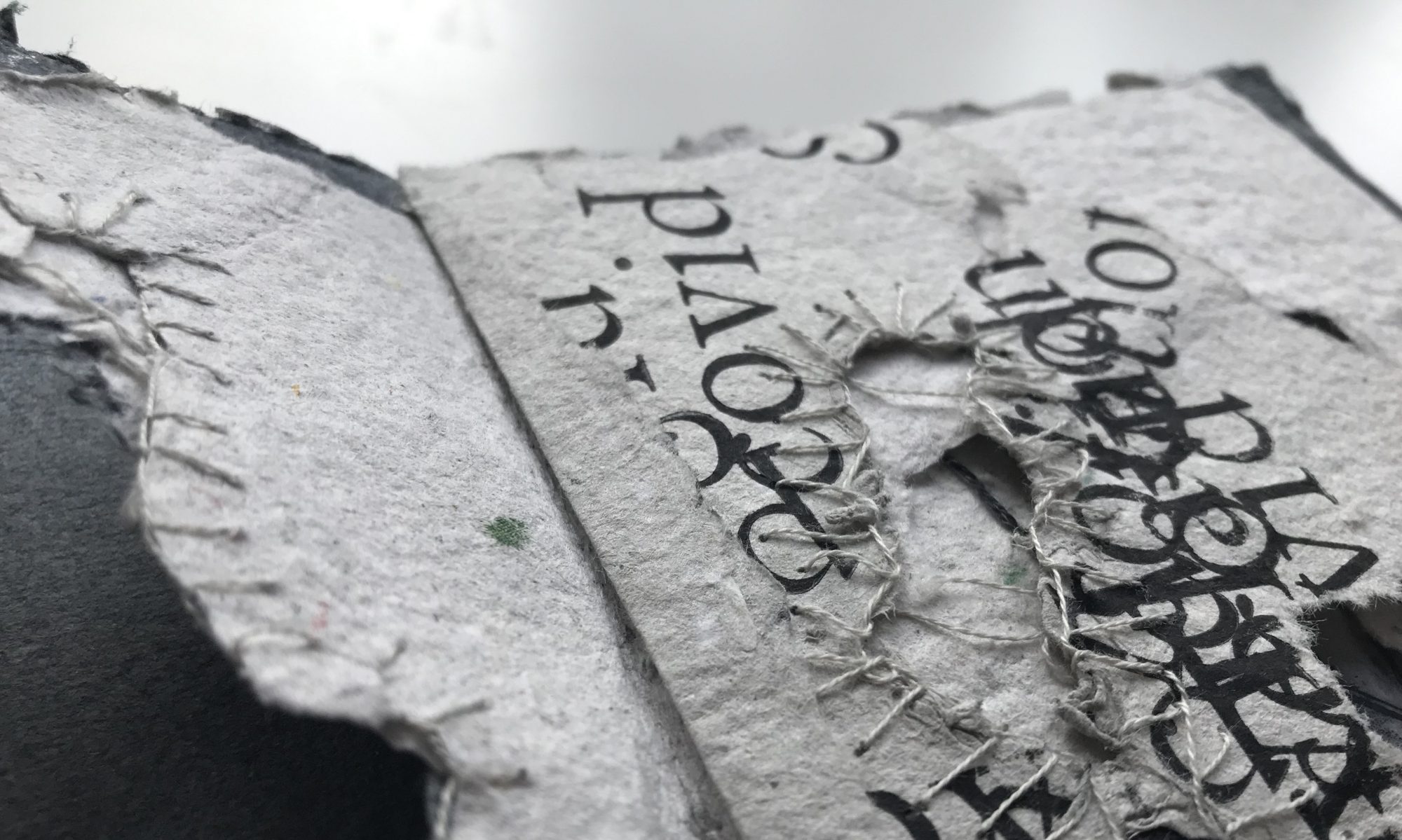
After looking back at my artist research I found that many of the artists I have been looking at that manipulate and build with paper either make or use paper which have stronger fibrous qualities and contain fibre such as abaca and flax, these are natural fibres. Abaca is the fibre stripped from banana palms which is then processed and cooked and dried to form the fibre. This makes sense that the artists combine this material to give durability and strength. As well as retaining the opaque qualities I enjoy within paper.

I wanted to give this material a go to see if this would make my paper more fibrous and strong. I am hoping I will be able to make thinner tissue like paper that has strength. After trolling through the Internet with not much luck locating uk based Abaca fibre. I came across a Norfolk based company that sell abaca pulp sheets (I was truly overjoyed!) which on the website state you blend and rehydrate accordingly and use like pulp. not only is this a traditional paper making material, it is also natural. I want to try and keep the man made material to a minimum although this is not always possible.
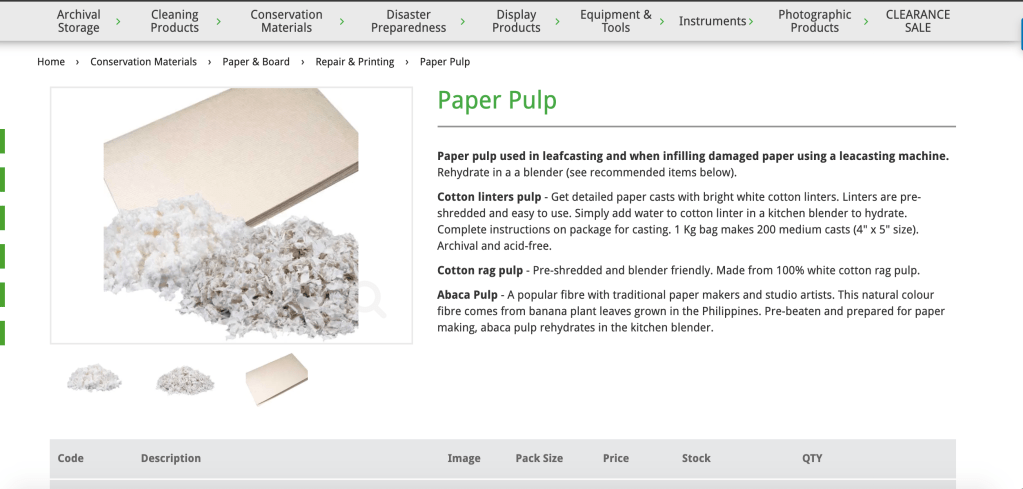
https://www.preservationequipment.com/Catalogue/Conservation-Materials/Paper-Board/Repair-Printing/Paper-Pulp-2

EXPERIMENT: making and manipulating paper

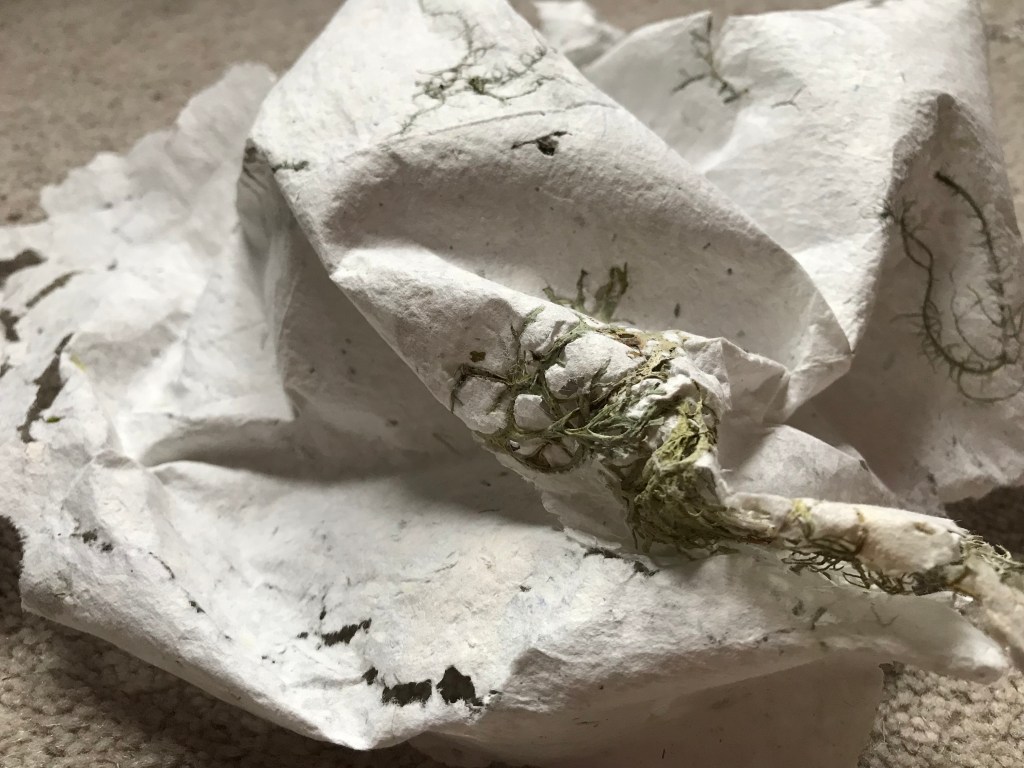
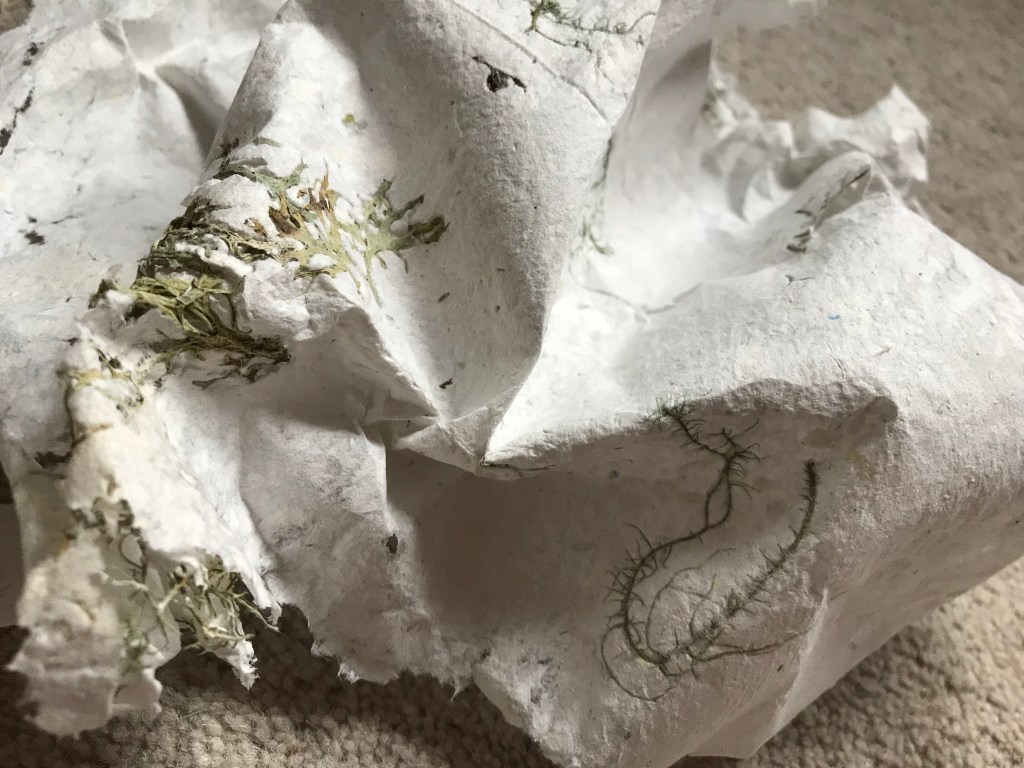
I reflected on the paper made previously and found that the I was struggling to manipulate and bend the paper made from recycled paper. This was because I was manipulating it into a shape once it had dried using a spray bottle of water( this almost disintegrated the paper, making it unworkable), the paper was extremely fragile and ripped as I was bending it.

I decided I would change the way I was working and experiment with manipulating . I needed to improve the strength of the paper as well as the quality. I made the paper thicker initially and arranged the forms into a shape while they were wet. This seemed to work to hold the shapes but when I came to further manipulating and holding its own weight and the folds it struggled.

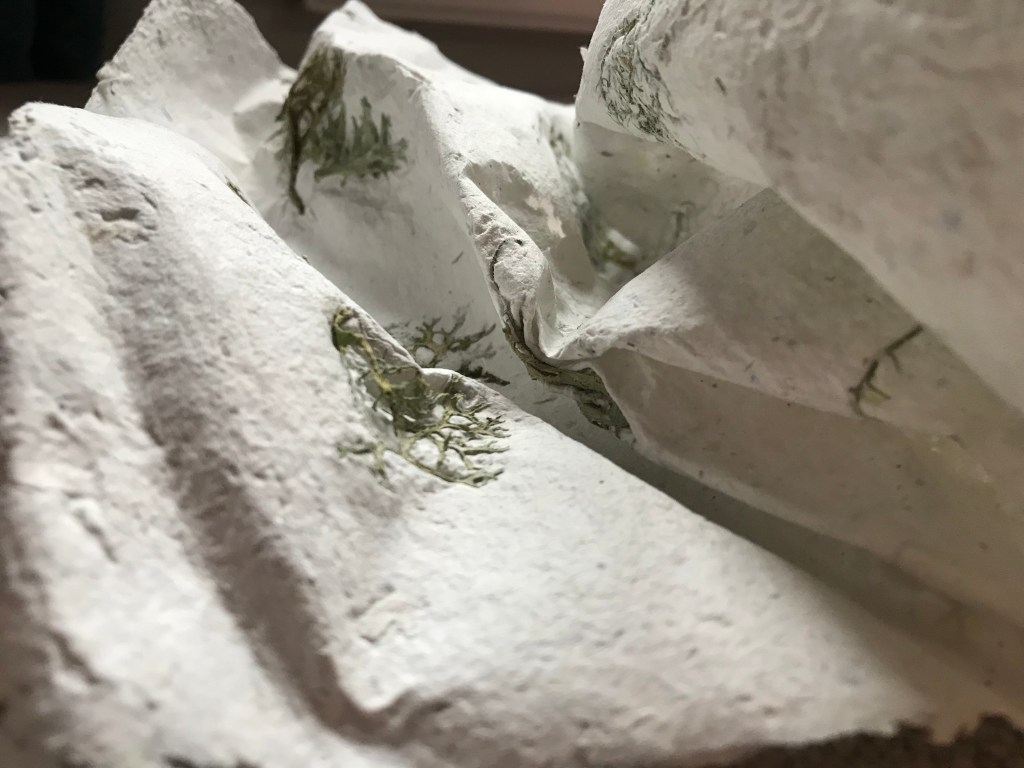
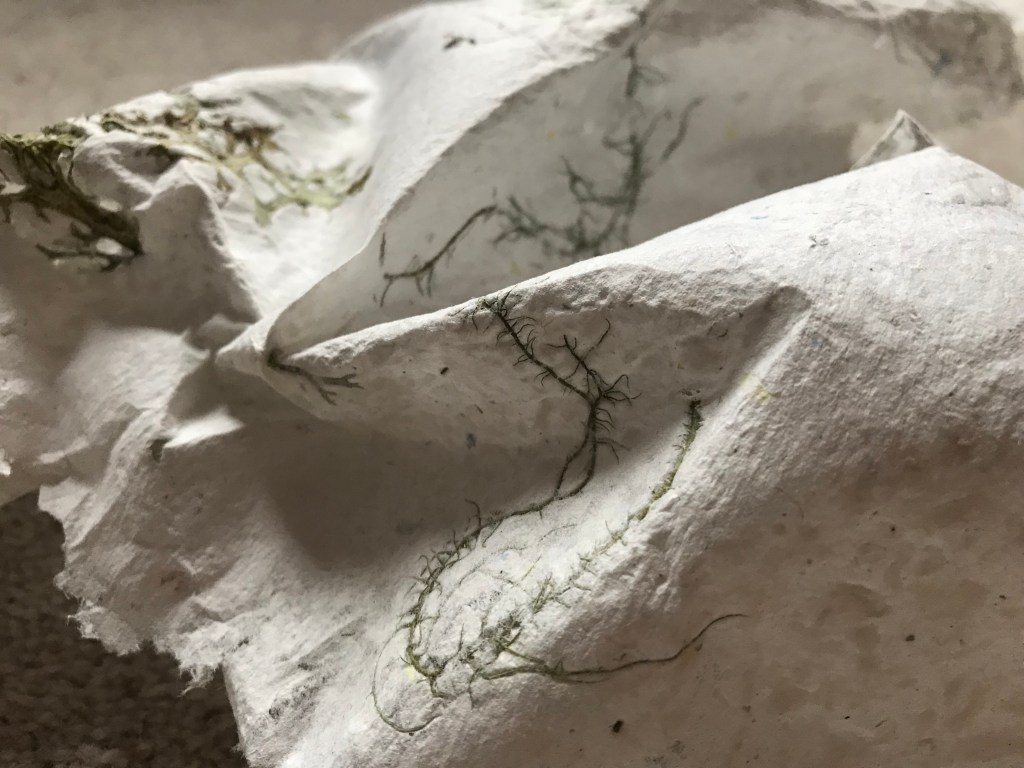
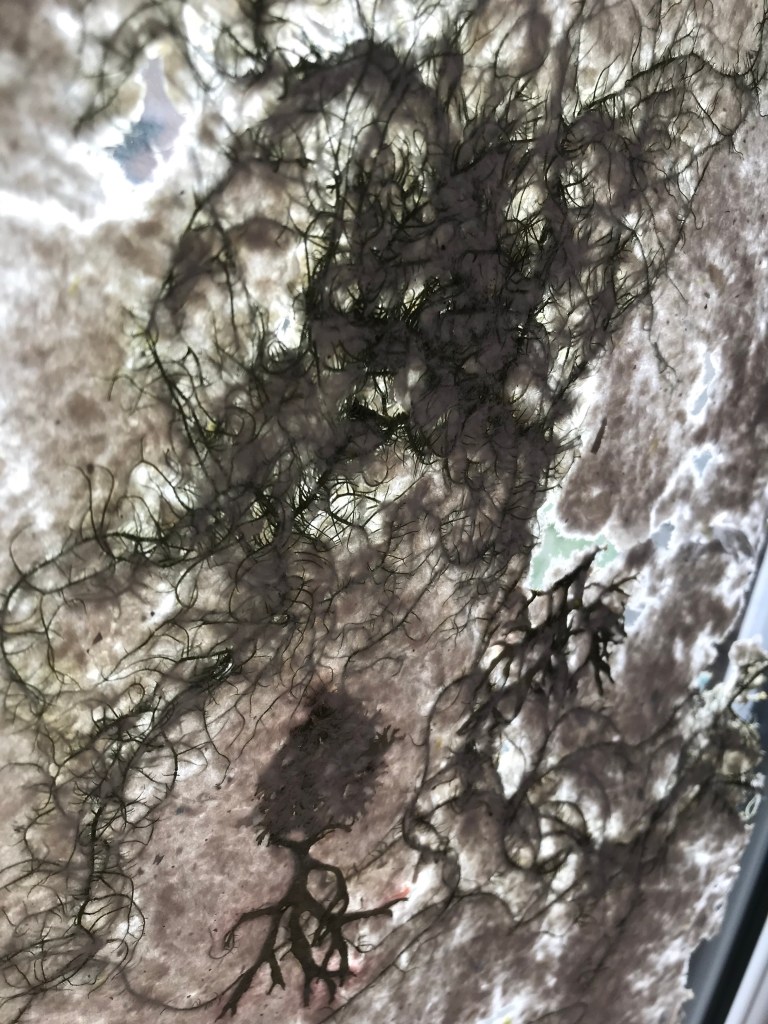
Although this was not very successful I enjoyed the way the folds created shadow and interest to the paper and how the lichen integrates into the paper. I want to continue to explore this but find a way to support the structures and strengthen the paper.

CHANGE IN IDEAS: due to materials and access

After researching various artists and book binders I have found many have supportive work that sits alongside their artist books. This is something that has caught my attention as I dont have the materials or access I need to sew and make books. This isn’t too far from my skill set rather focusing on the material of paper in an alternative way.

As a result, I have decided to focus on paper manipulation and construction (this was initially discussed with my 1:1 with Ingrid). Moving Forward I want to concentrate on the ways I can manipulate my cotton paper and further combine the lichen that I had foraged. I want to explore ways I can make a sculptural form with paper. How far I can push the paper and how I can support it as well as what form it takes. This will be something I will have to explore through trial and error.

As soon as I can have access to the materials, I am keen to make an artist book that sits alongside the sculptural pieces.

MAKING PAPER: experimenting with techniques

After looking at paper manipulation and construction artists who use a wide range of approaches to making and working with paper I wanted to decide on the best way to approach making paper, so that the material qualities (fragility, strength, fragmentation and opacity) I want to explore are used to make the most effective whole sheets of paper.

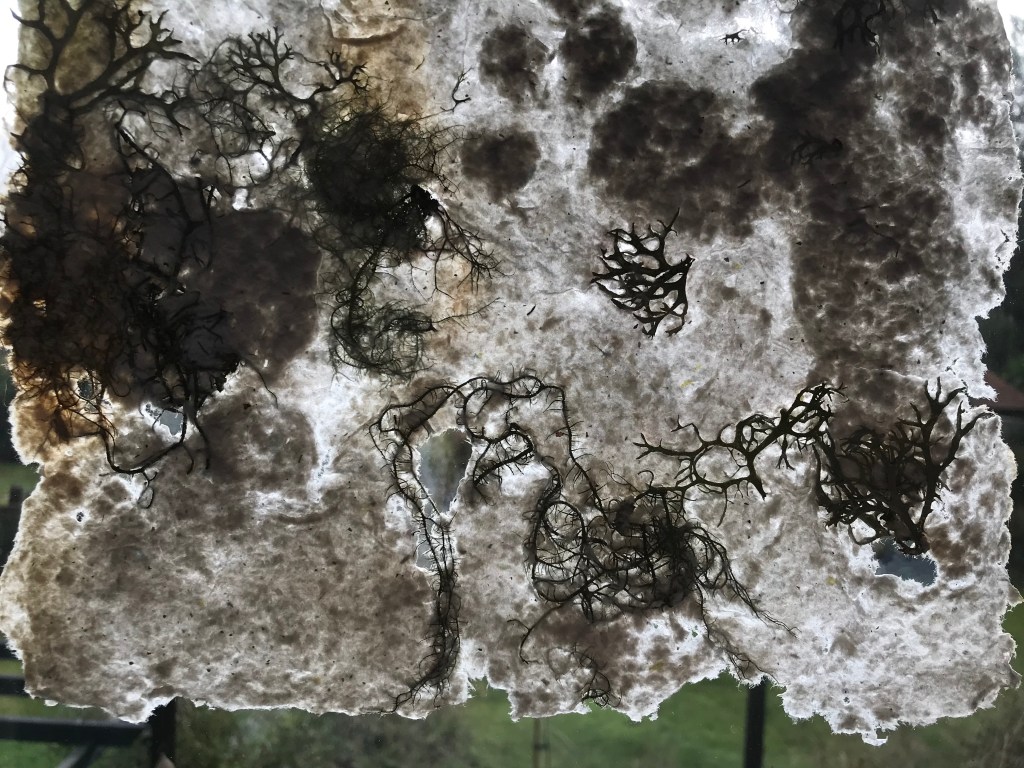
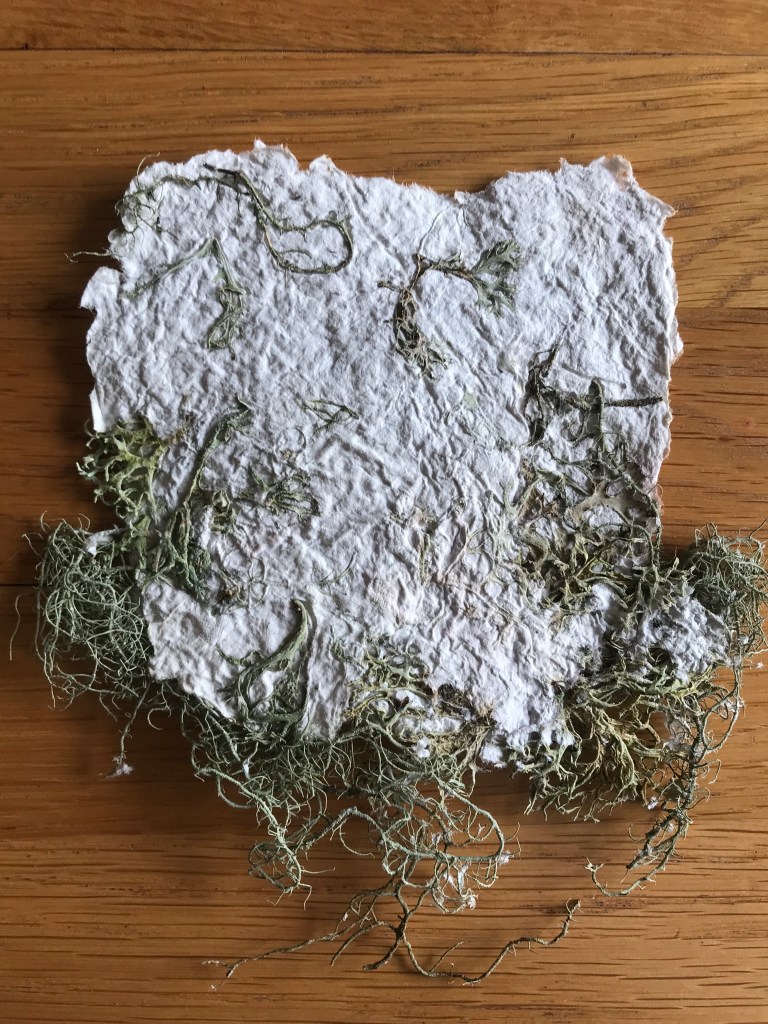
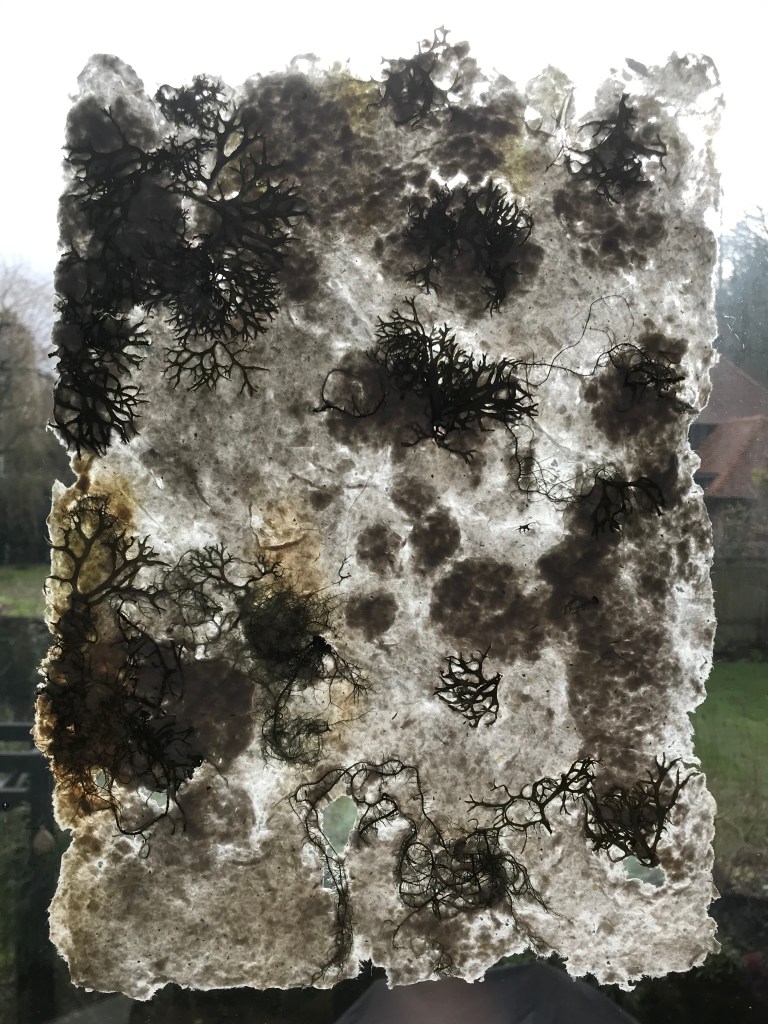
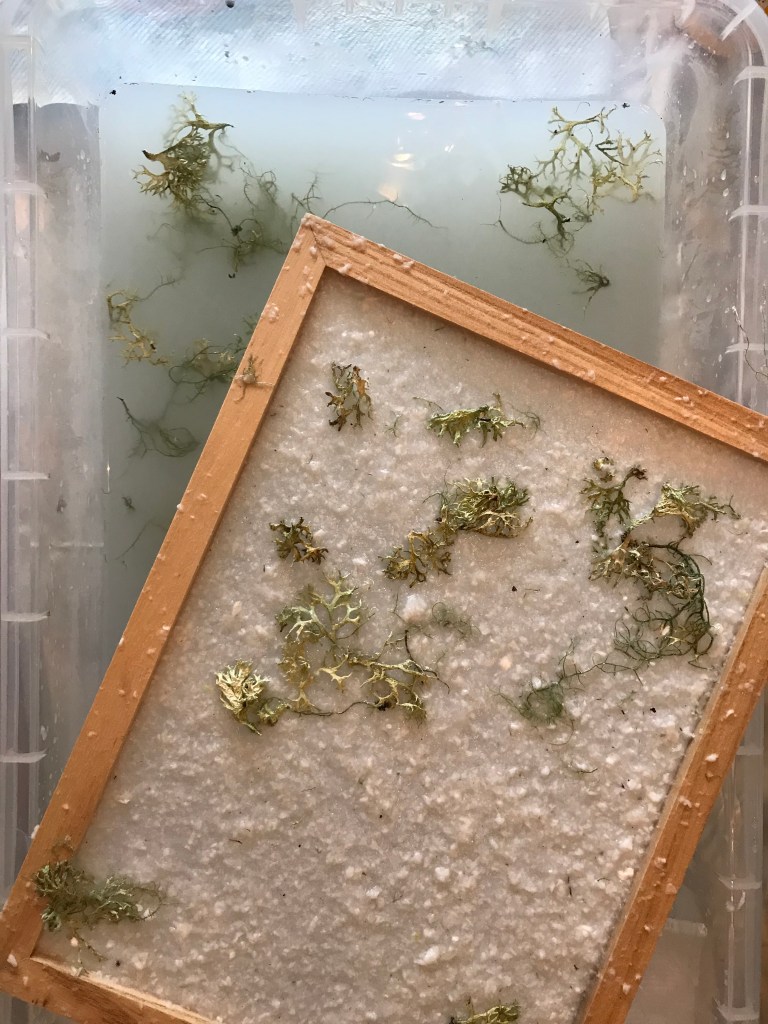
I found the trickiest part of making this paper was combining the the lichen ( fallen, that I had collected and dried from the New Forest) so that it retained its structure but also spread evenly and interestingly across the paper. I attempted a variety of approaches to do so.

The least successful was placing the lichen onto the paper once I had formed the paper sheet, this was because the licken was not embedded enough into the paper and tended to spring out, furthermore this was a very controlled way of making the paper and I would prefer this stage of paper making to be more natural and unpredictable. I had also tried to control the paper pulp much like a paper mache medium and layering the lichen between the pulp, this was successful to get lichen that dangled from the paper but the down side to this was that the paper was too thick and had lost its opacity and became too ridged to manipulate.
The most successful approach was to submerge the licken into the paper pulp and as I drew the frames to the surface the lichen formed a more natural pattern embedded within the paper that had the fragility and opacity that I wanted.

Moving Forward I want to explore ways of creating tone with the paper and colouring the pulp to create more interest around the lichen (to see if this would add or subtract from the natural patterns) and start to manipulate the pages by bending curving and folding to see how far I can push the paper until its fragility gives in. As well as this I want to start to bring in another stitch element into the paper to exaggerate some of the manipulation as well as mimic the lichen.

COLLECTING MATERIALS: New Forest

I live extremely locally to the New Forest, I wanted to use as locally sourced or natural materials as I could to experiment with (where I can) in order to make paper. I have previously used Lichen in paper and the results were extremely successful. This material interested me for its geographical locality as well as its natural and interesting appearance. These are also indicators of pollutants and grows extremely successfully within the forest because of its low pollutant levels. The lichen grows on the trees making them look hairy in some cases. I only picked licken off the floor or dead wood that had fallen of the trees. I brought them home dried them out and separated them. Moving Forward, I will combine these with my paper making.

  • Idea: This has made me consider how and if it is possible to keep these living or have plants that grow within the paper, I am not yet sure of this idea due to the fragility, but this could be something I could explore and whether it is possible to then manipulate the paper?

ARTIST RESEARCH: Jennifer Davies

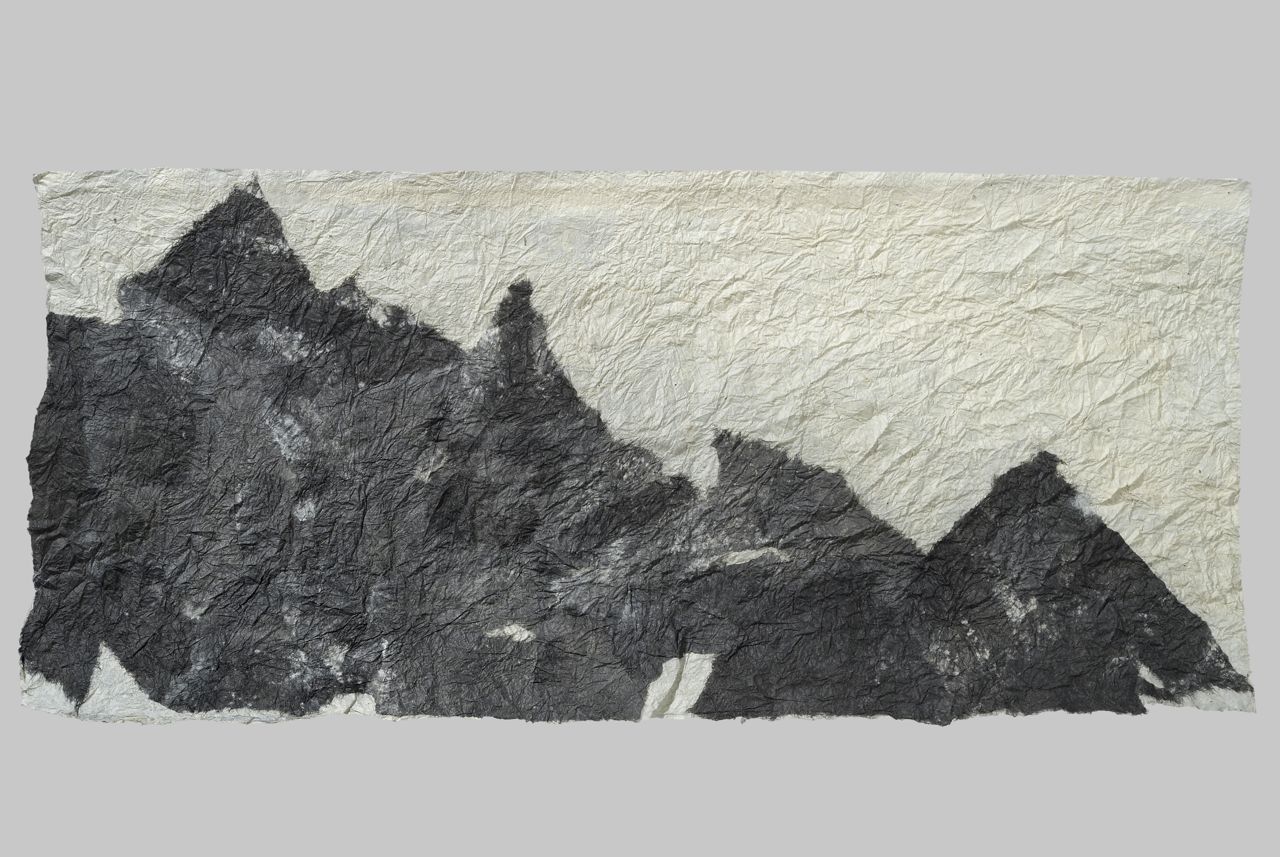
  • Jennifer Davies is a paper maker, sculptor and constructor, using hand made Japanese paper manipulated, twisted, collaged and constructed to create forms that explore the materialities of fibrous material.
  • She often collages and constructs with both hand made paper and pulp.
  • Often combining stitch and dye.
  • Heavily inspired by natural textures and materials.
  • http://www.jenniferdavieshmp.com/
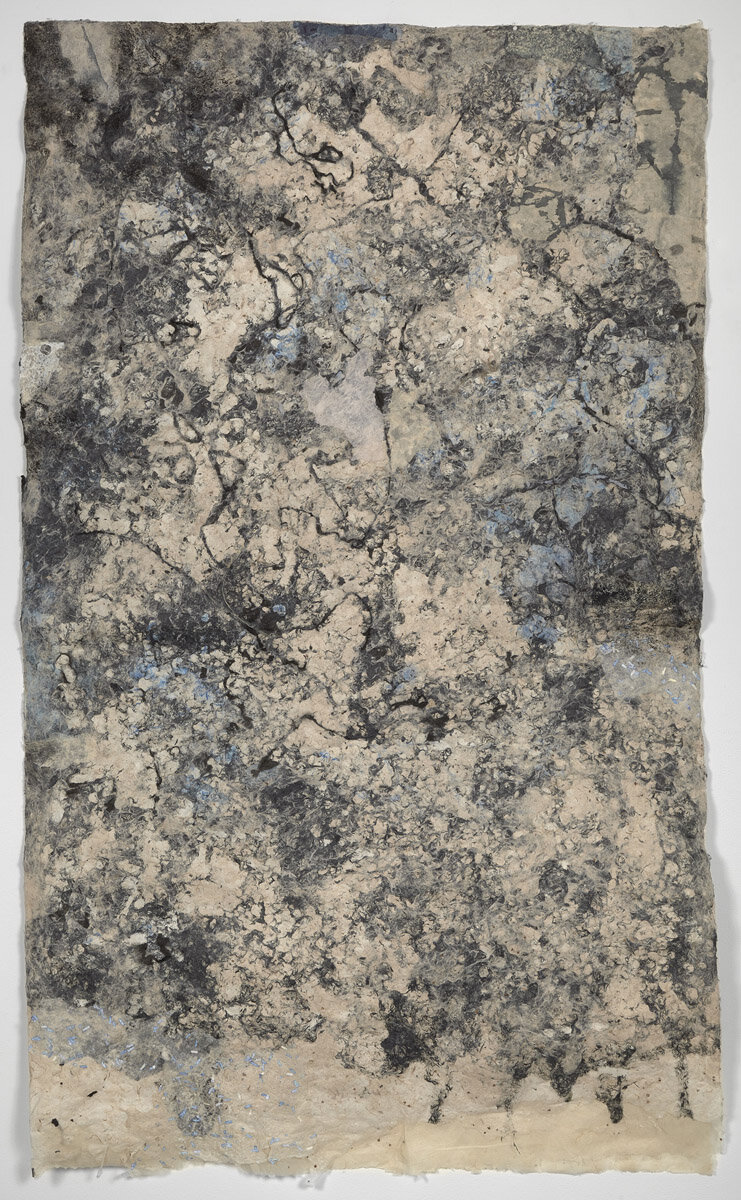
Tracing the Moraine
Tracing the Moraine (http://www.jenniferdavieshmp.com/)
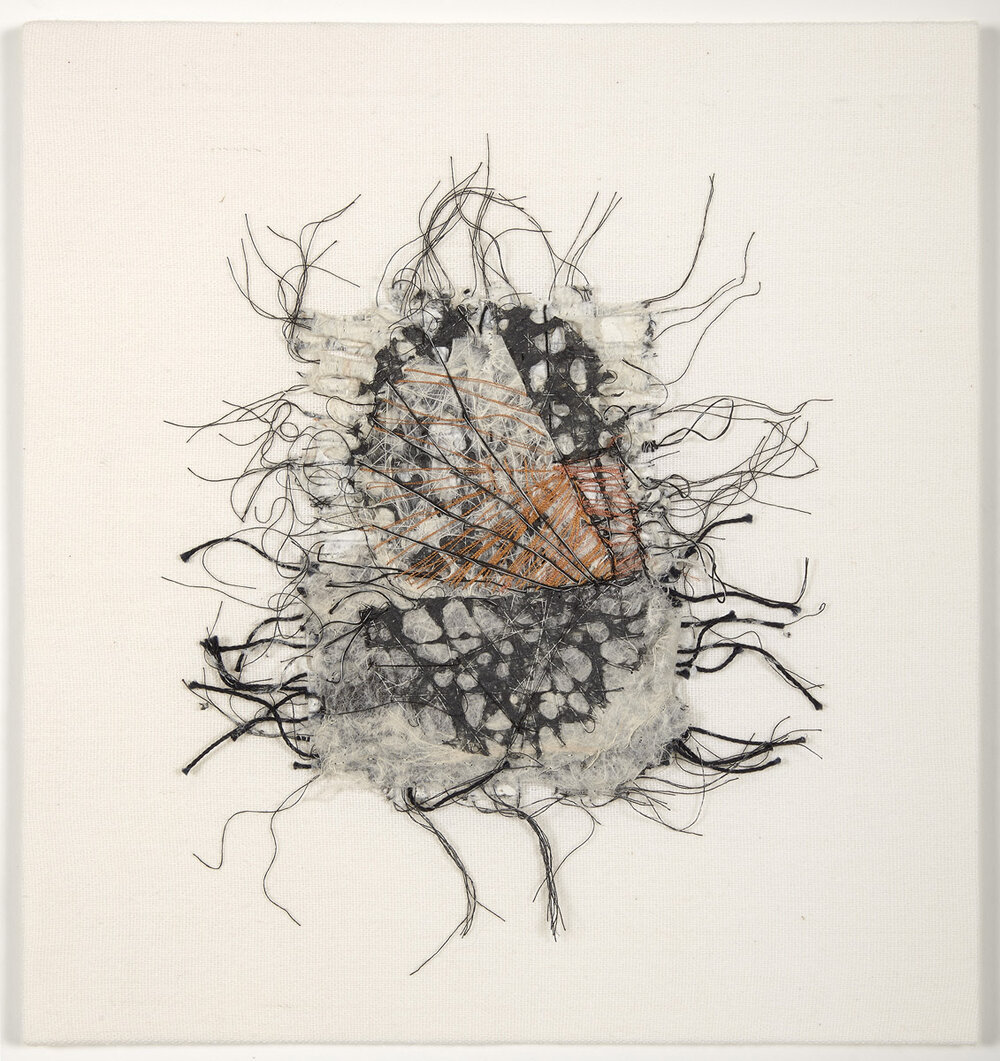
Doodled
Doodled (http://www.jenniferdavieshmp.com/)
  • Davies work has made me consider focusing more on natural inspiration, working similarly with construction and collage? This would work well to make my work look less two dimensional ( I want to explore manipulation of paper, with more of an interest in pushing it into 3D).
  • It could be interesting to work with collage and multimedia, previously I have used stitch in my paper work which creates another textural dimension as well as increase the depth detail.

ARTIST RESEARCH: Aimee Lee

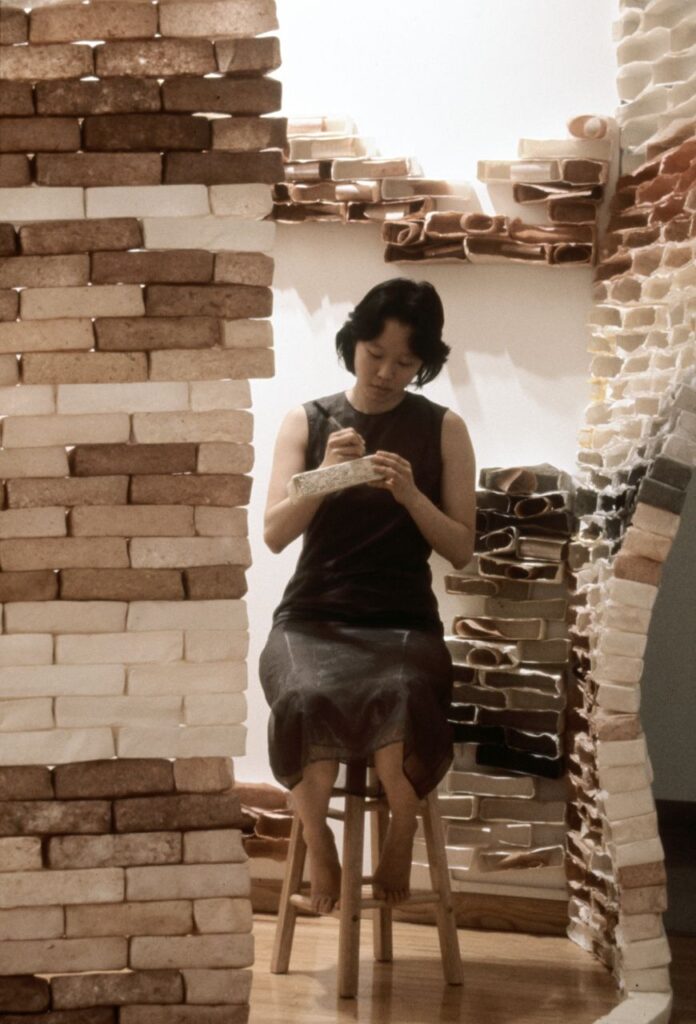
  • Aimee Lee works with paper manipulation, process and engineering, both using her Korean heritage and traditional paper making techniques.
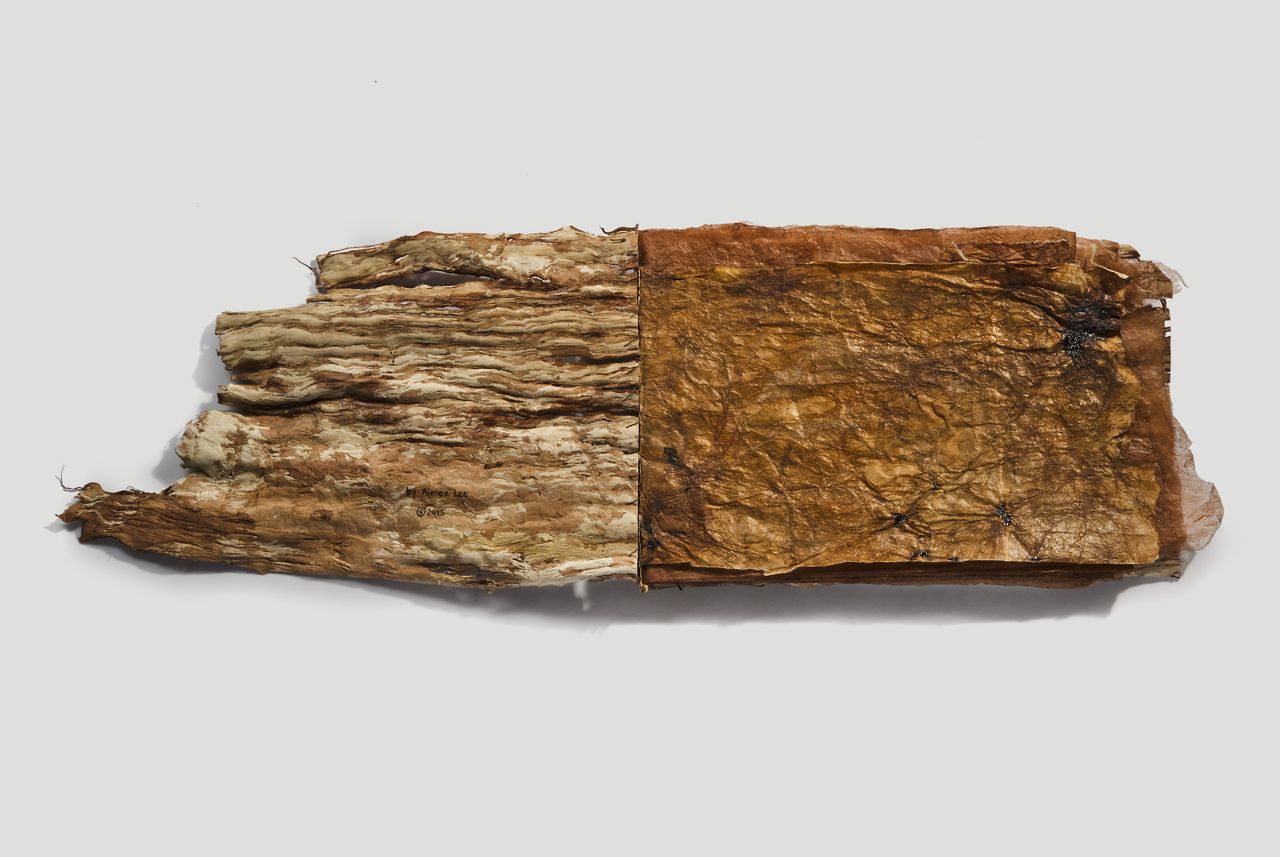
  • She makes and constructs paper, sculptures, installations and books.
  • Lee often reconstructs and uses paper that she had made from hand, tearing the sheets and building them up, posing the challenge that come with the construction of paper, durability, fragility and transparency.

“I source materials and techniques from my Korean heritage, though my interest in plants, colors, and traditions derives from global fiber methods. Through artists’ books, I began to make paper and fell in love with the constant motion of water, the ecologically sound process of manufacture, and the variety of wild materials I could source” Aimeelee.net. 2021. About Aimee Lee | Aimee Lee. [online] Available at: <https://aimeelee.net/about/.

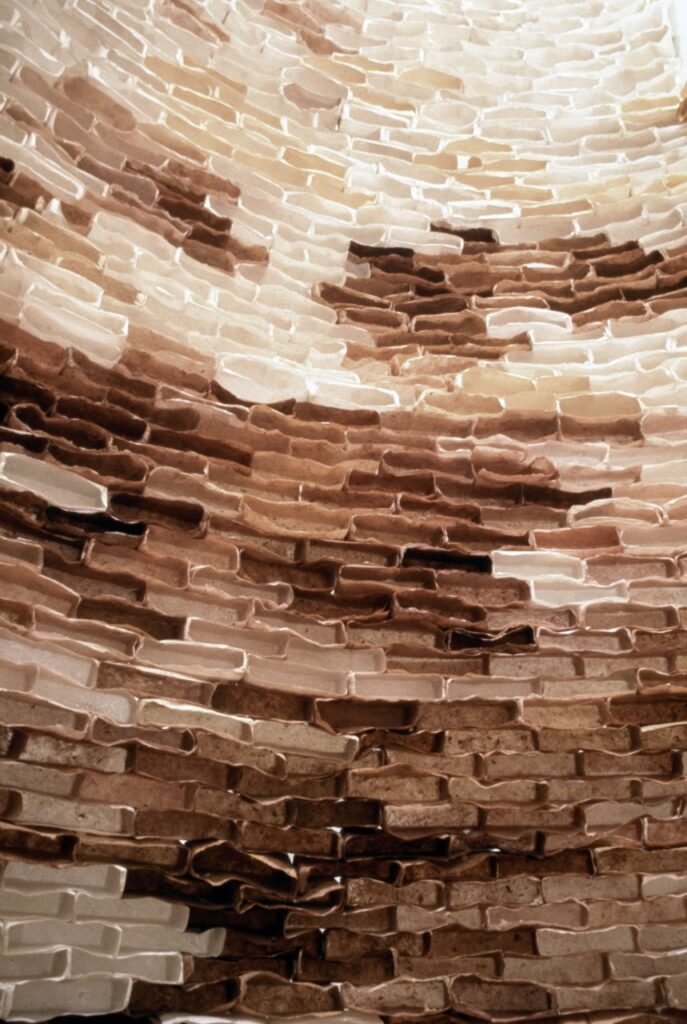
She Inhabits it, 2006 (https://aimeelee.net/performance/)
Rising, 2011 (https://aimeelee.net/paper-icons)
Lapse Relapse 2015 (https://aimeelee.net/artists-books/)
  • Lee’s work has made me consciously aware of how I can use paper in construction, taking great care and interest in its origins and material state.
  • By understanding why, where and how I source and make my paper from will inevitably create the depth and contextual knowledge that gives my work powerful meaning.
  • taking inspiration from natural resources and using fibrous materials will allow for me to construct with the papers with heavy resemblance and inspiration from my location, geographically speaking.

EXPOSURE MODULE: initial ideas

IDEAS AND REFLECTING ON PREVIOUS PROJECT

  • Expand and reflect (and show) how my research has informed my work. Synthesis.
  • Referencing ideas, theories artists that inform the work. really unravel and explore historical understandings, concepts materials. Show why these are important. Contextral.
  • Explore a wide range of materials and techniques, play with the ideas and really get to grips with the ideas of a book. Exploring formats and really understanding the boundaries and limitations.
  • Contextualise my own ideas more.
  • Where does my work belong understand why I am making my work, whos the audience, what gallerys, what collections, why would want it?
  • Professional context.
  • Play with the limited materials and techniques that are available to me. Don’t see them as limitations, look to really develop unique skill.
  • Look into paper based art forms, making paper, construction, manipulation (how can I manipulate the materials, what can this do to the form, consider how this would look digitally) engineering, sculptures.
  • Context, is the paper of any significance, what am I making it from, historical/ location based meaning?
  • location based work? use what i have available to me where I live currently (Hampshire, new forest) Orif IDs (not sure how this is spelt) objects that live in the physical and digital world, mapping location, tracking movements, tracking materials.
  • deconstructing original books, repurposing, outsourcing hand made papers?

ARTIFACT 2: evaluation and reflection

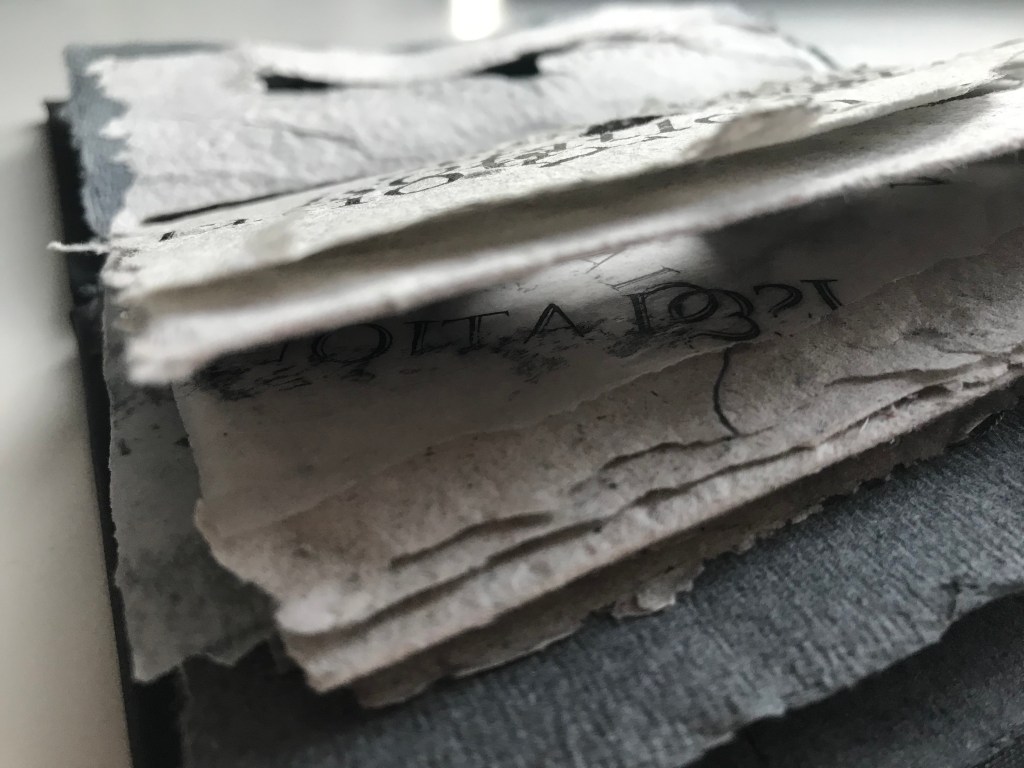
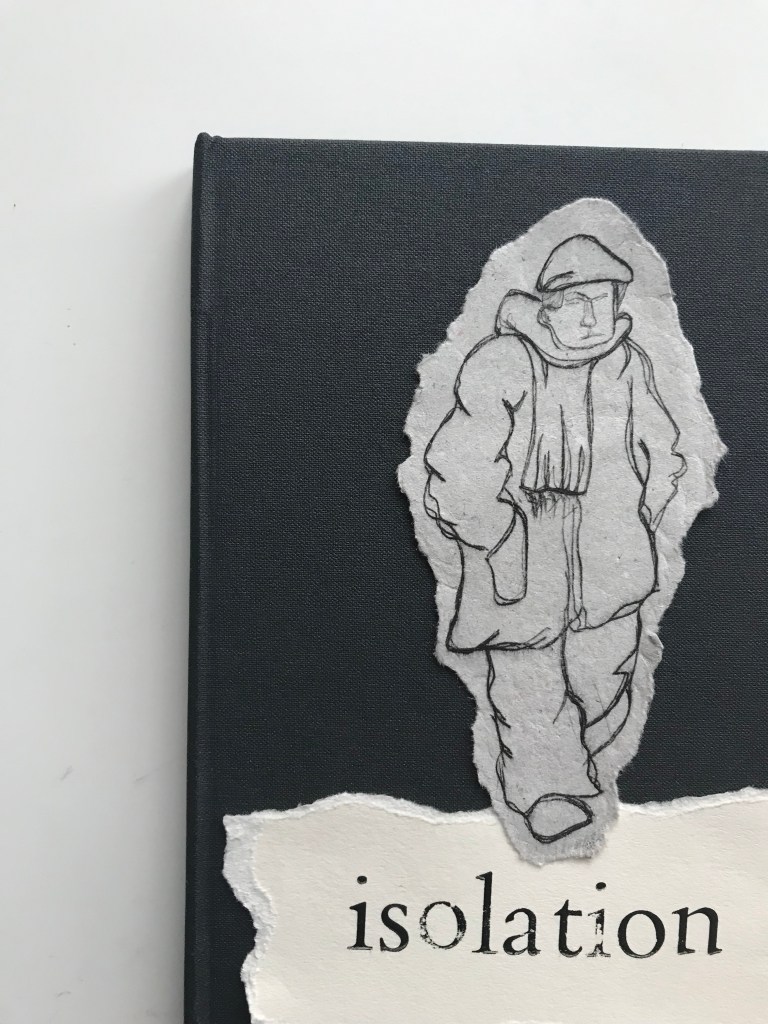
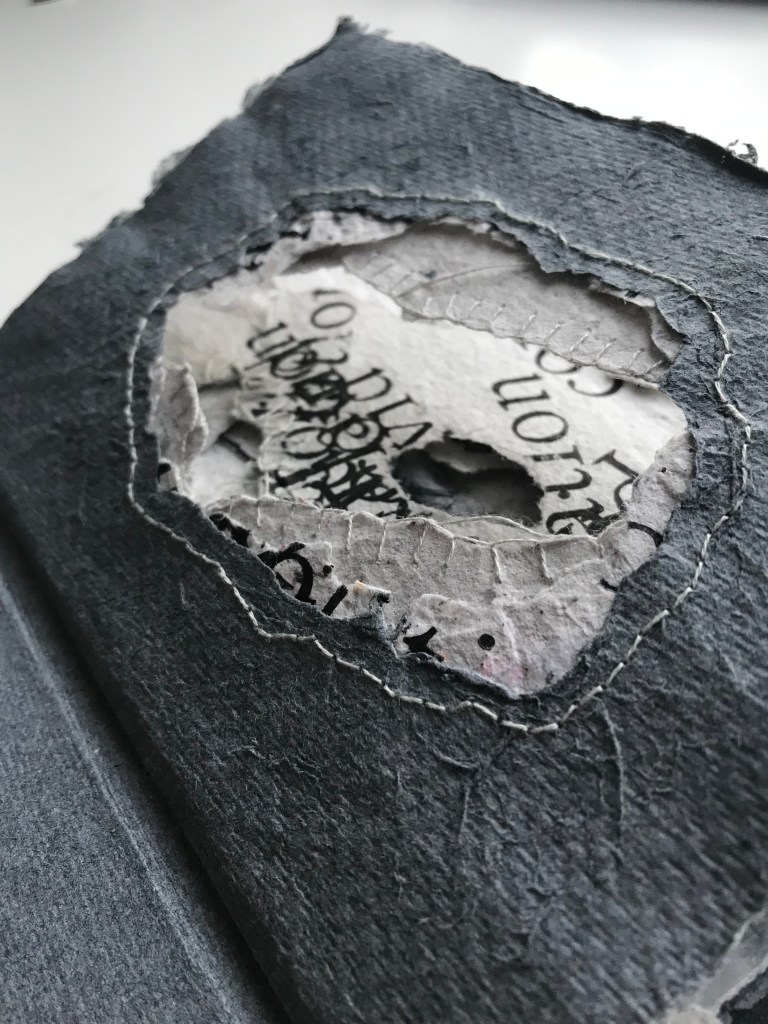
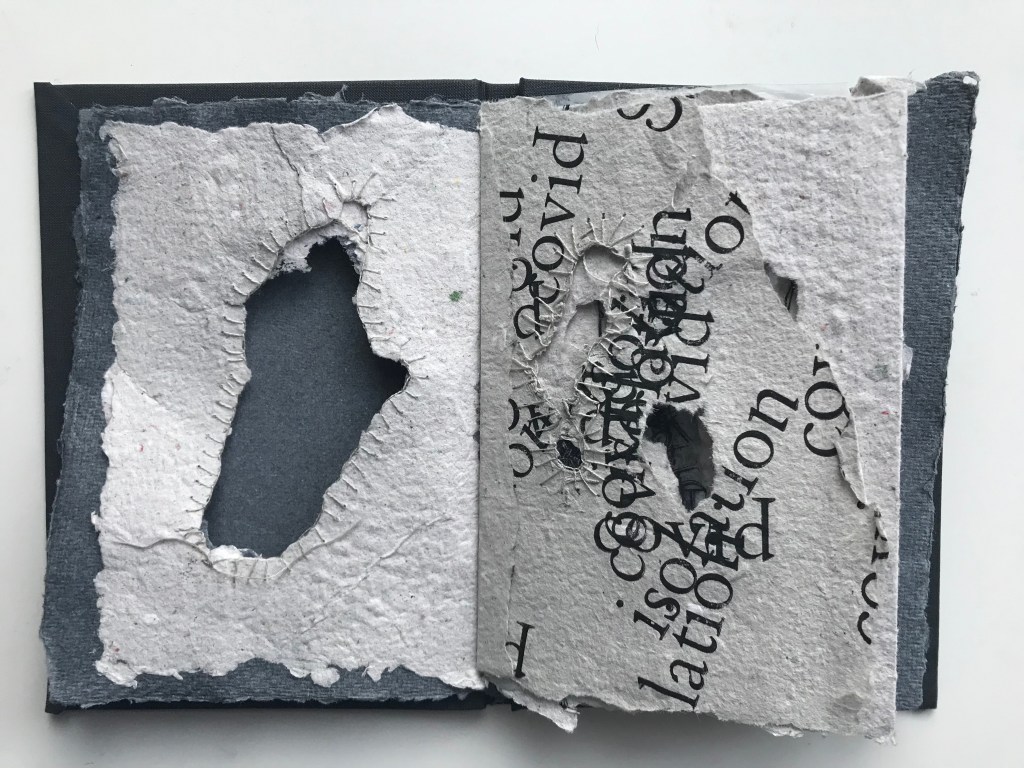
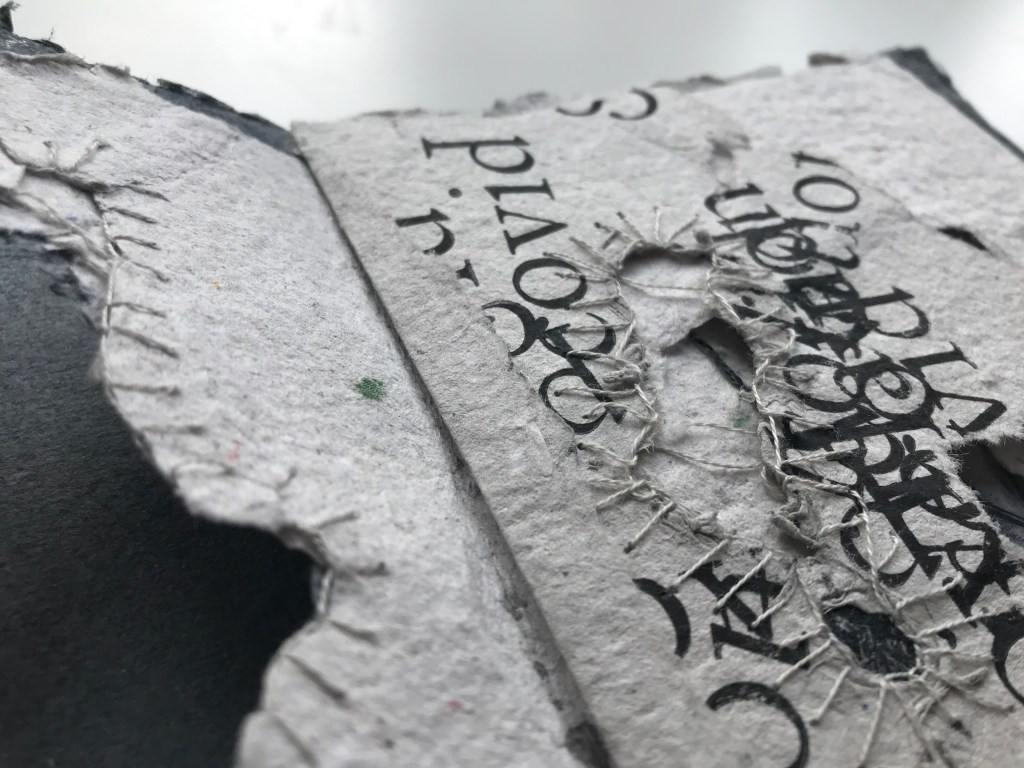
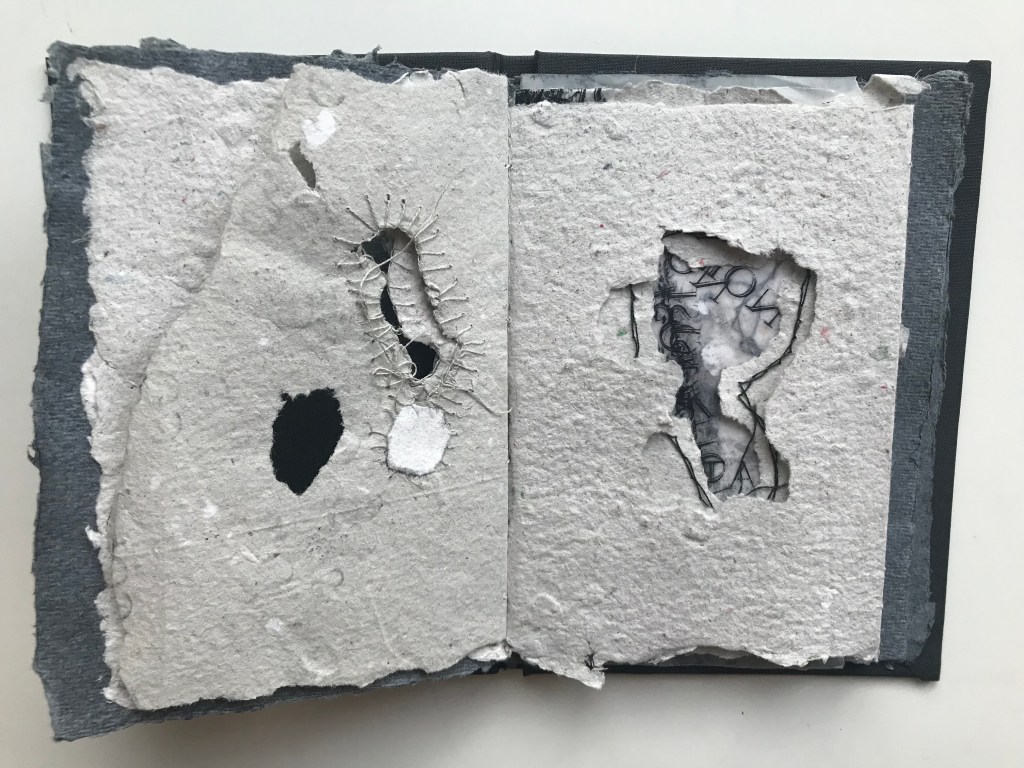
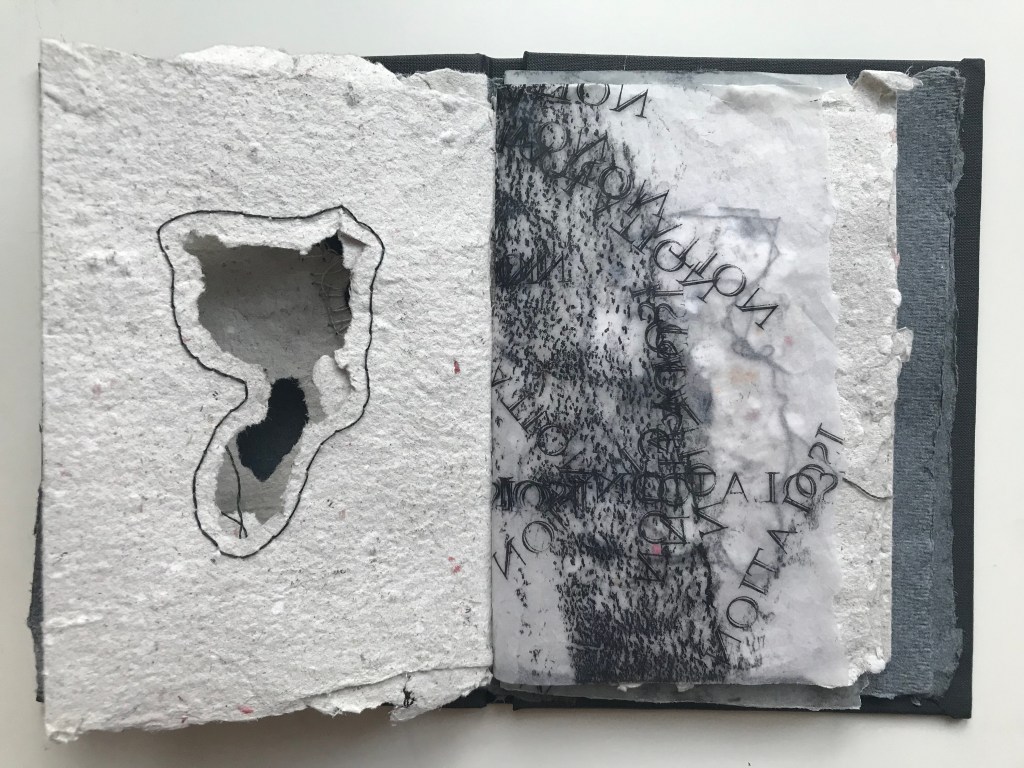
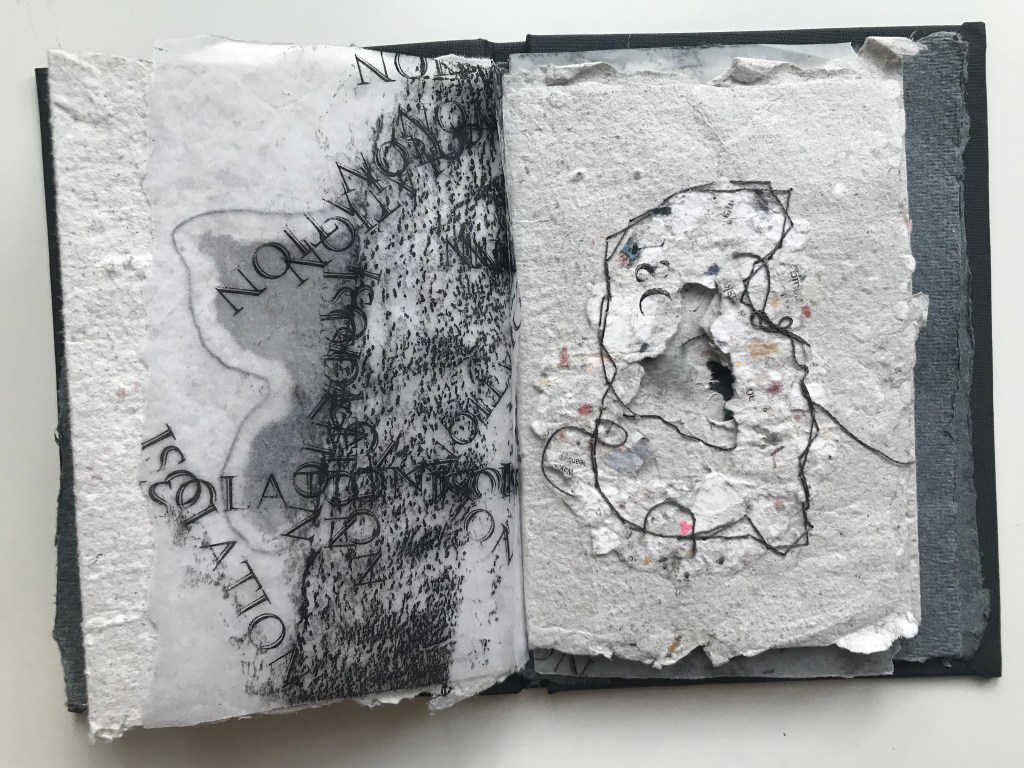
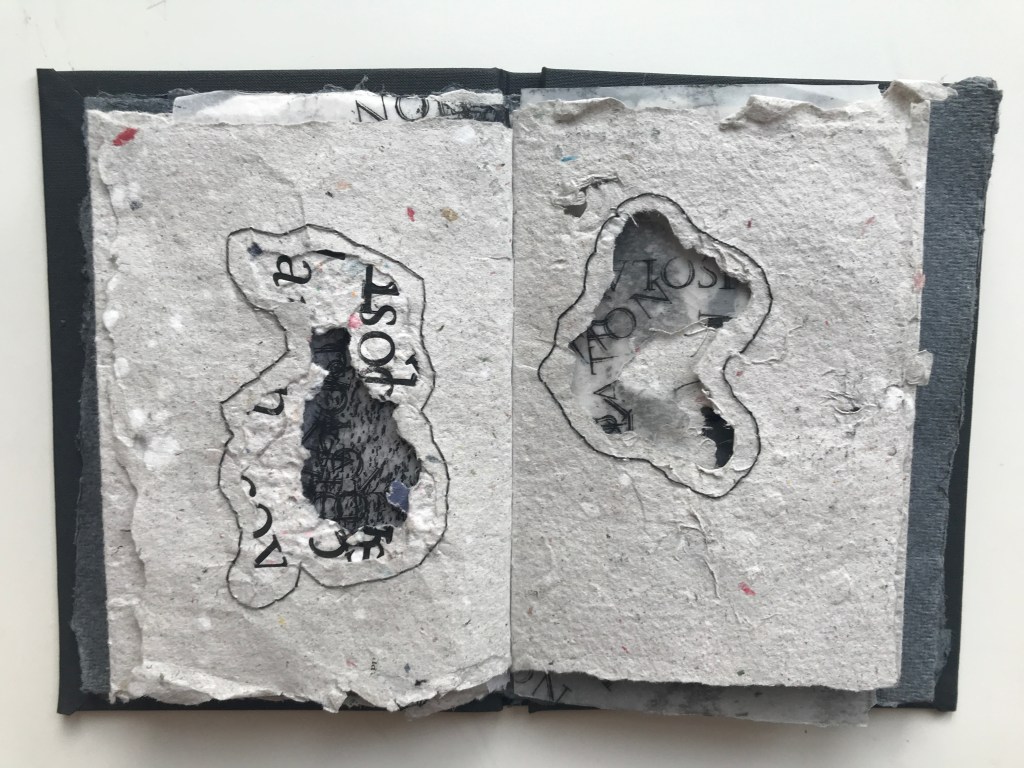
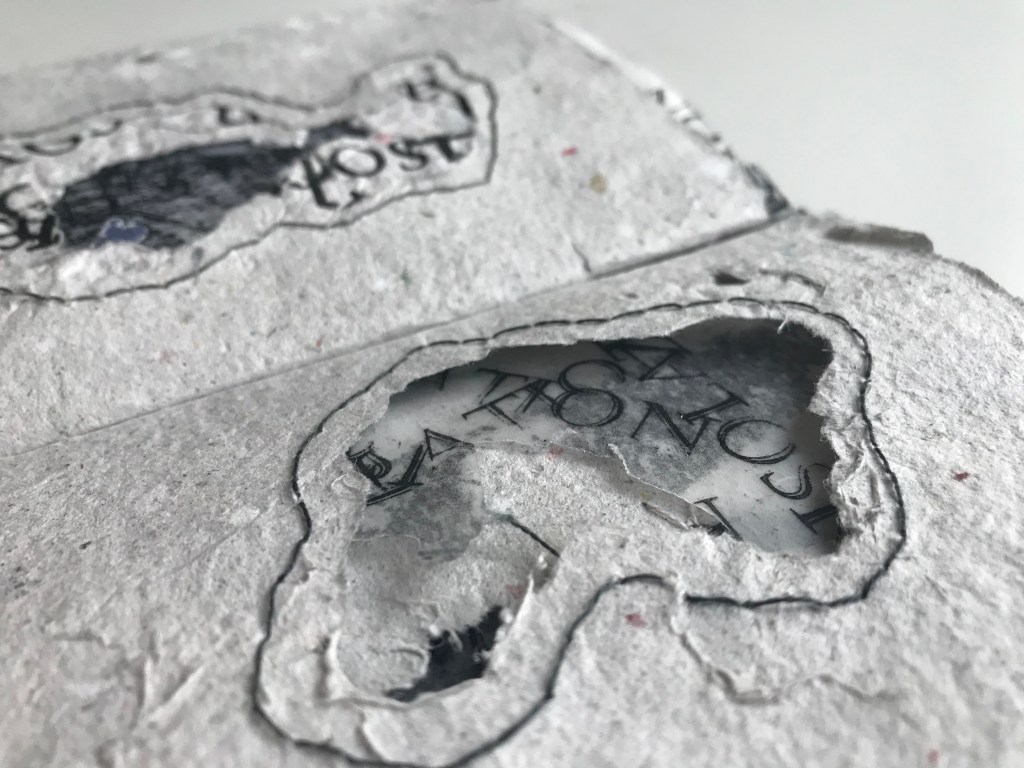
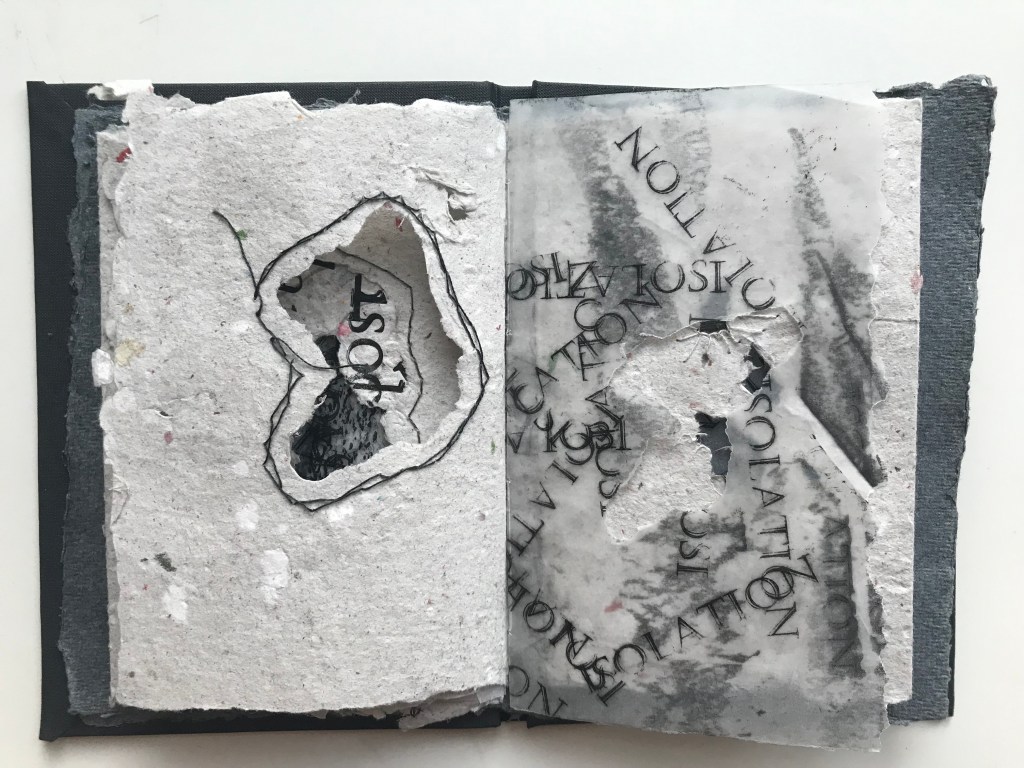
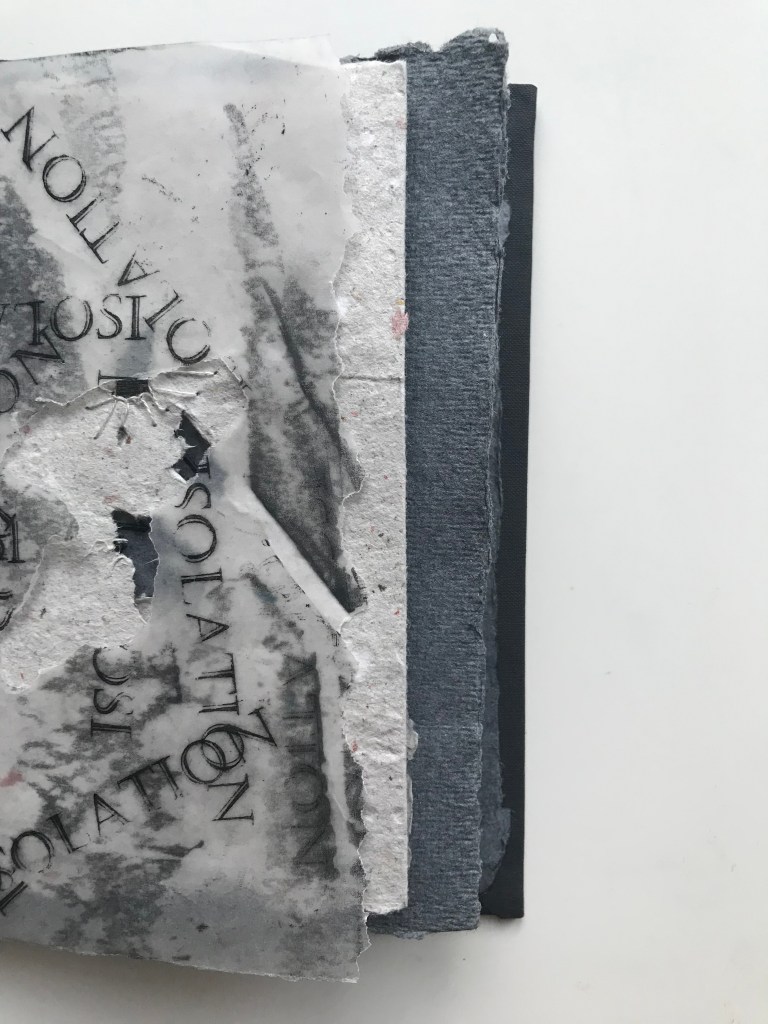
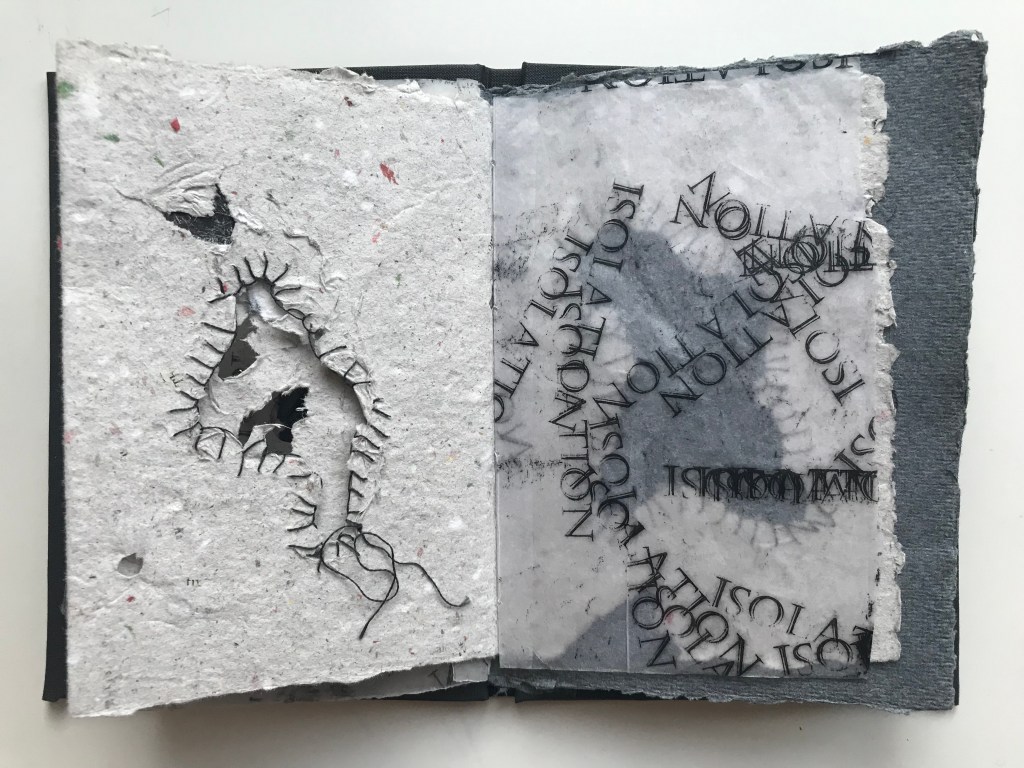
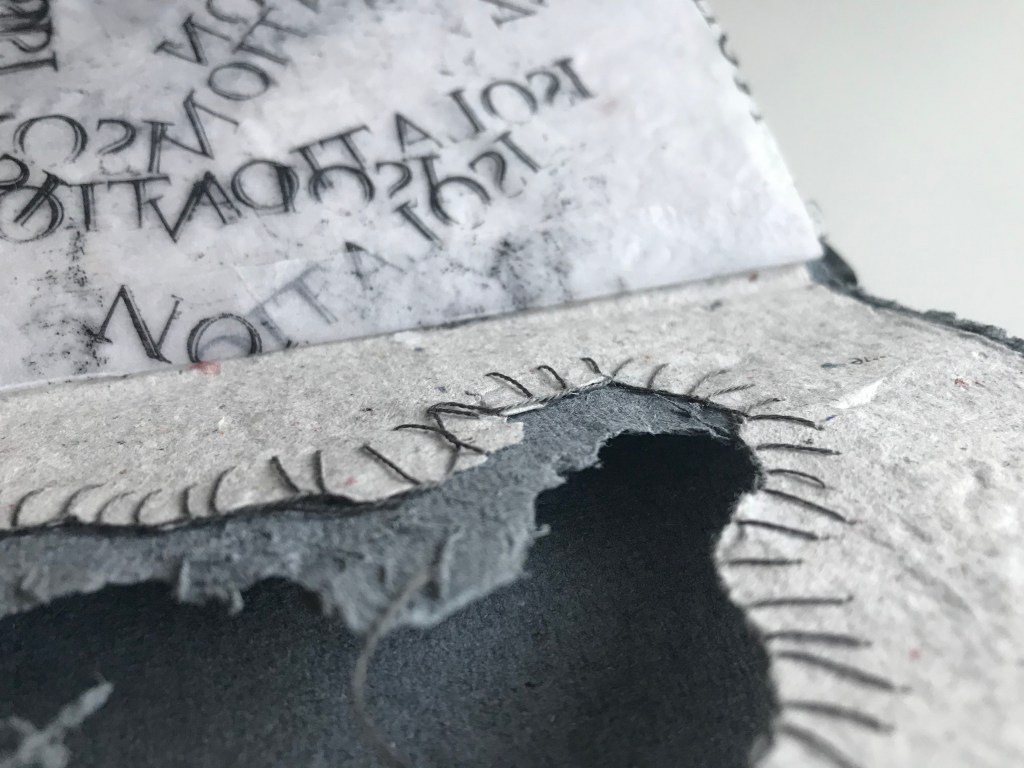
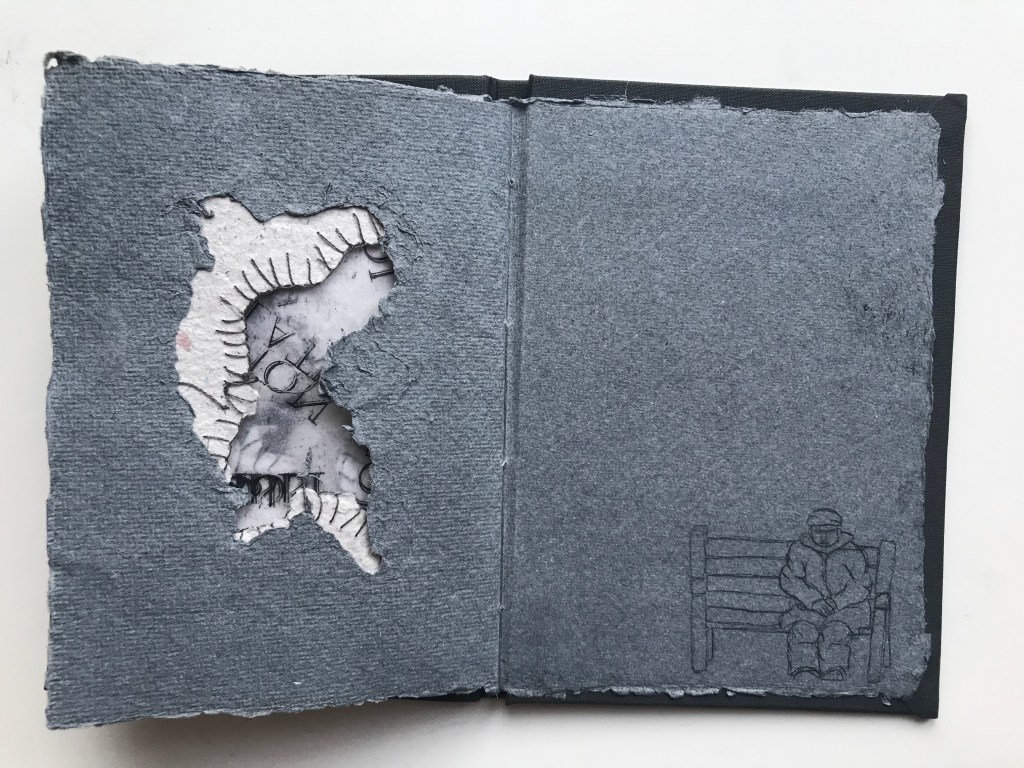
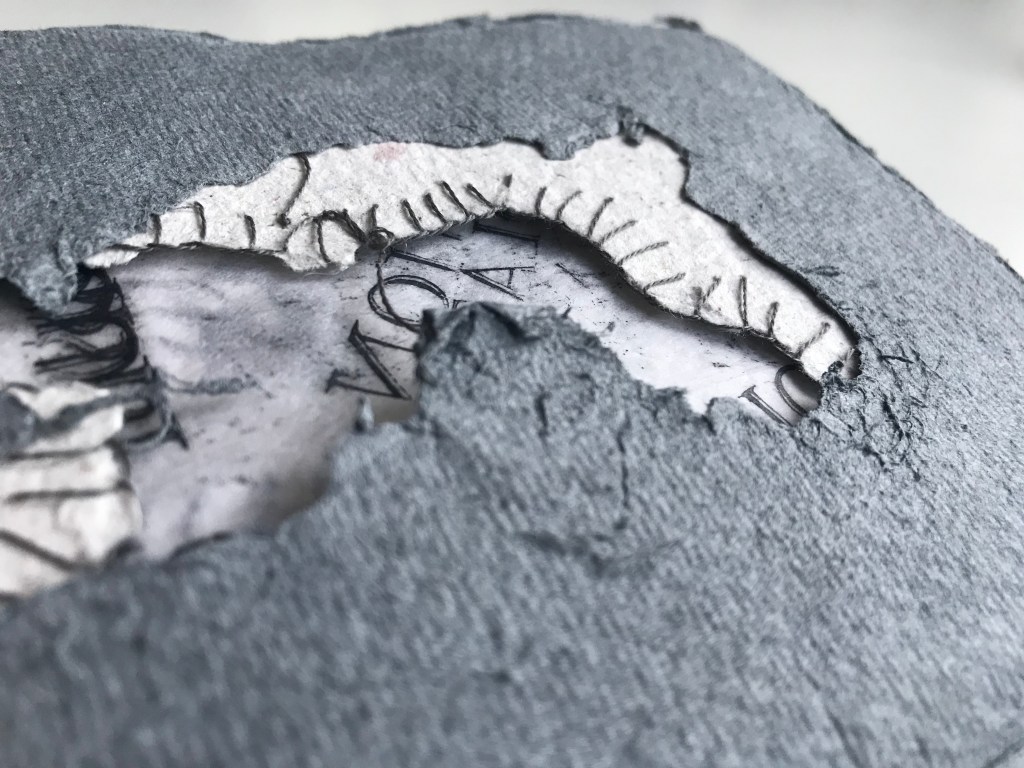
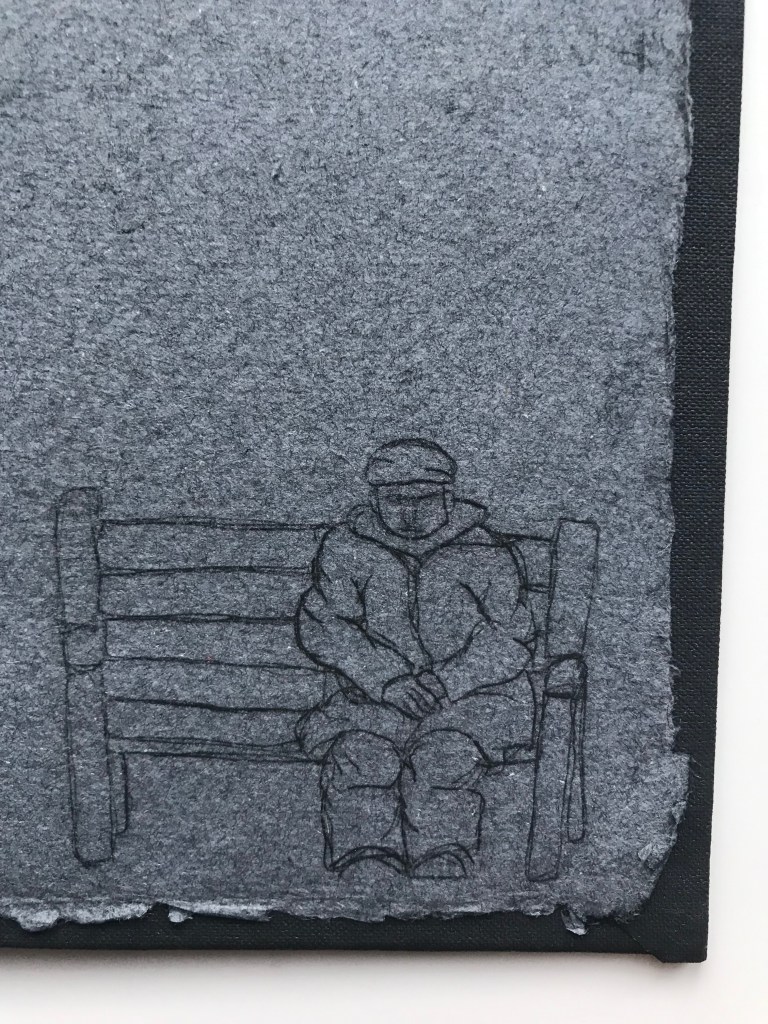
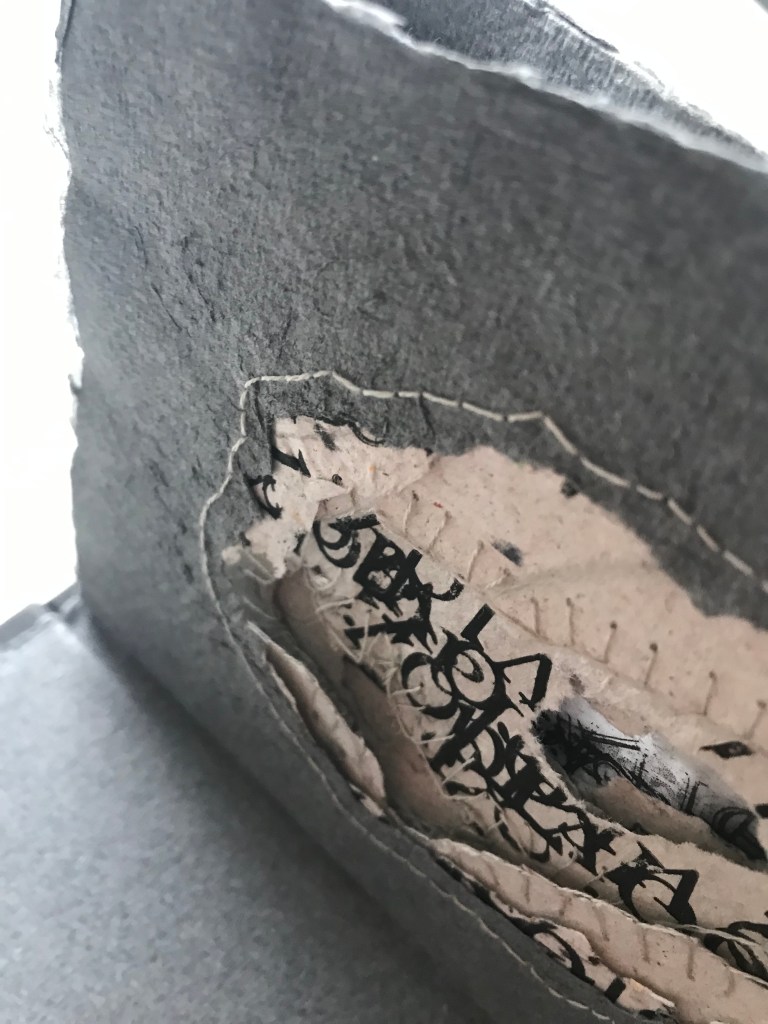
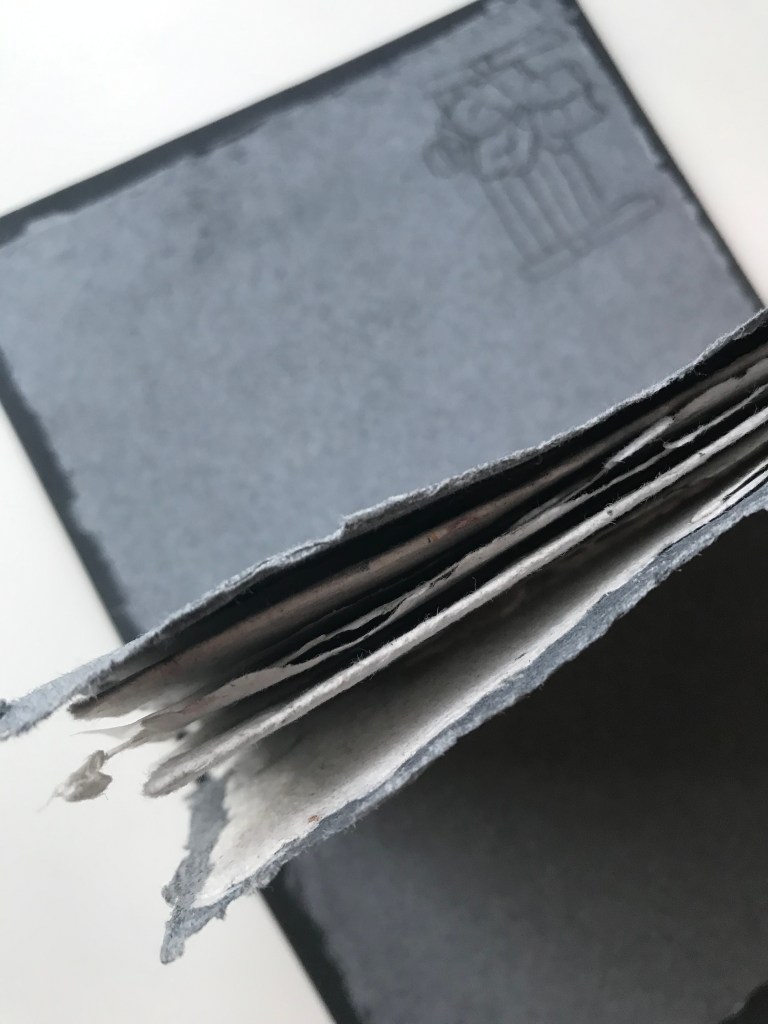
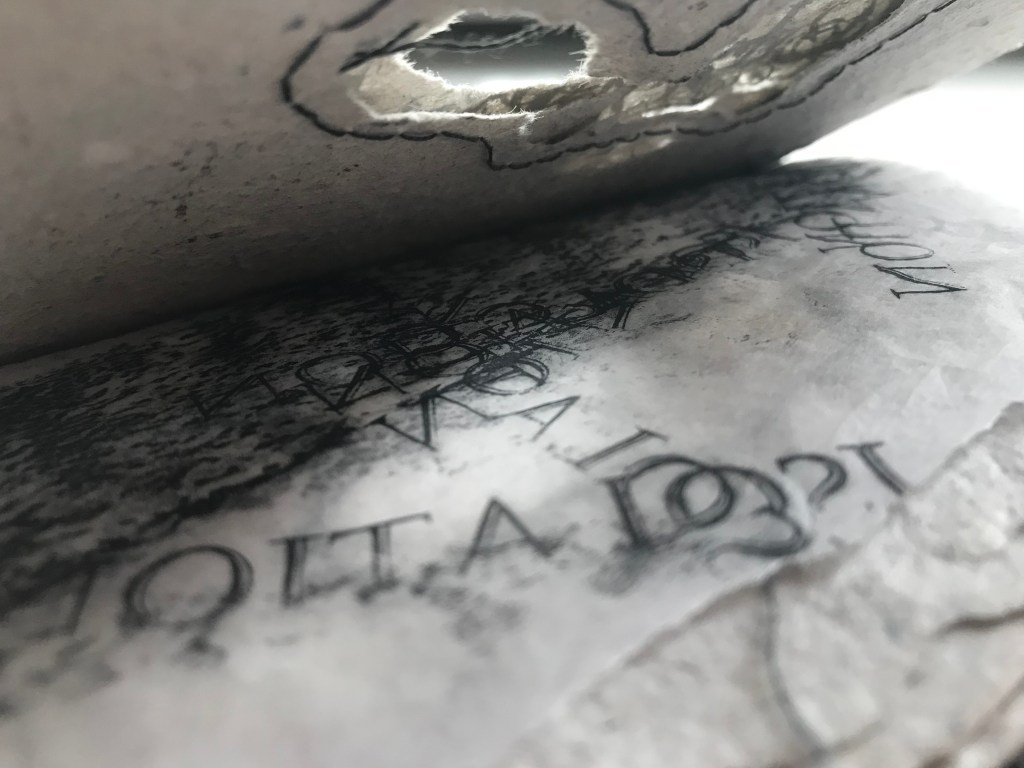
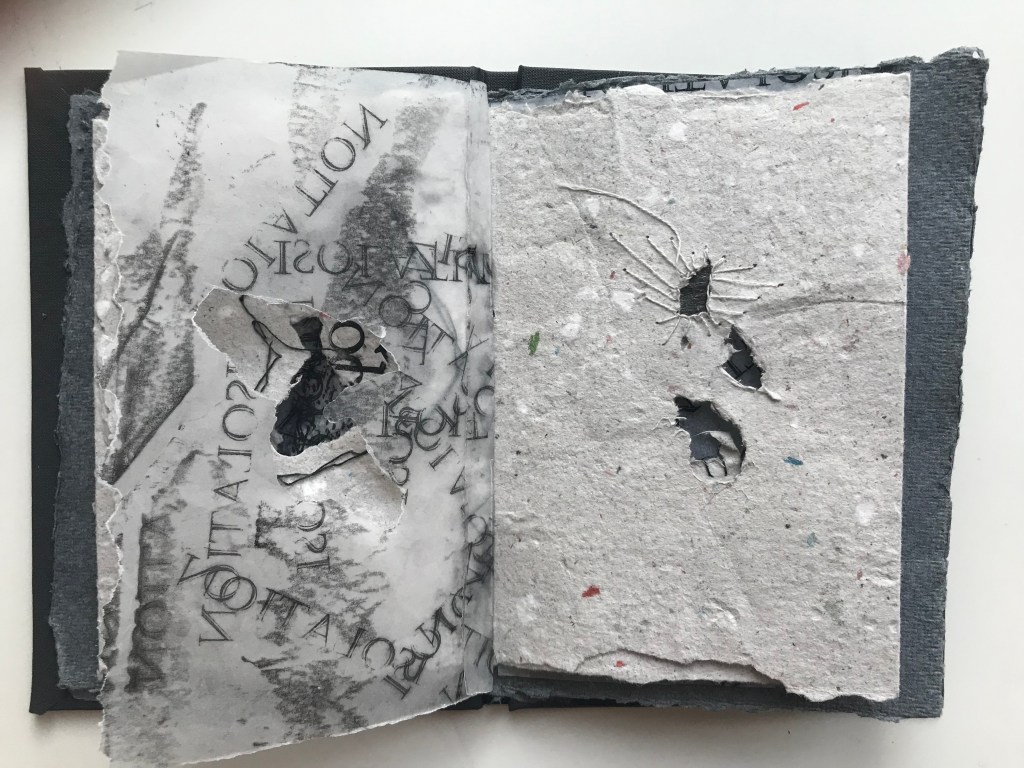
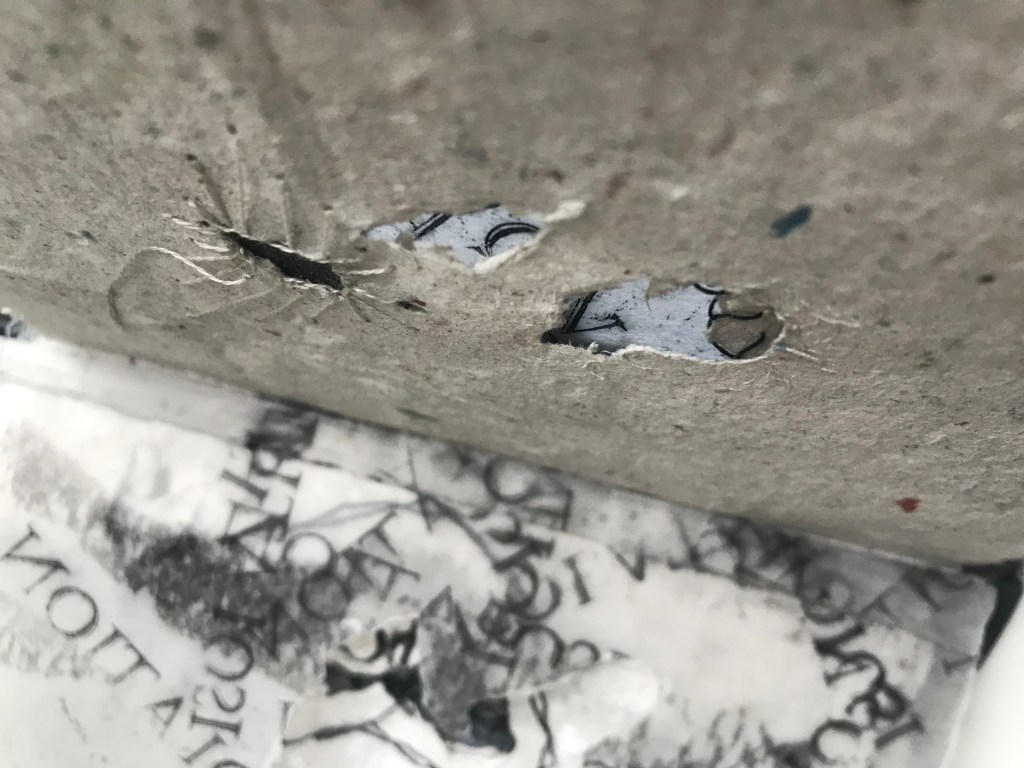
In whole I am extremely pleased with the outcome of my book. The effect of the overlapping pages I wanted to create the sense of entrapment and the feeling of being trapped within walls or your own mind as an effect of the COVID19 pandemic and the effect on the elderly and the vulnerable. I wanted this to be a direct continuation of my exploration into the bowl form as so that they work well as part of a collection. The book form became more of a sculptural form in its own right and this then successfully expresses the feelings without the need for text. i did set out what i wanted to achieve, which was a book that explores texture and material quality, and the senses. with translucent qualities that allows you to see through the book. I wanted this to be a more immersive experience for the viewer, that they would work their way through the book and experience or get a sense of what I am trying to intend. the most challenging element of this project was the idea development, I knew what I wanted to create, the processes and the techniques but i was still very unsure of where i sat as a practitioner and why I was making what I was making. I feel more confident now knowing after researching other artist book makers that exploring the senses or themes can create extremely unique and intricate books that adhere to my skill set and explore the processes and material qualities of paper that i enjoy immensely.
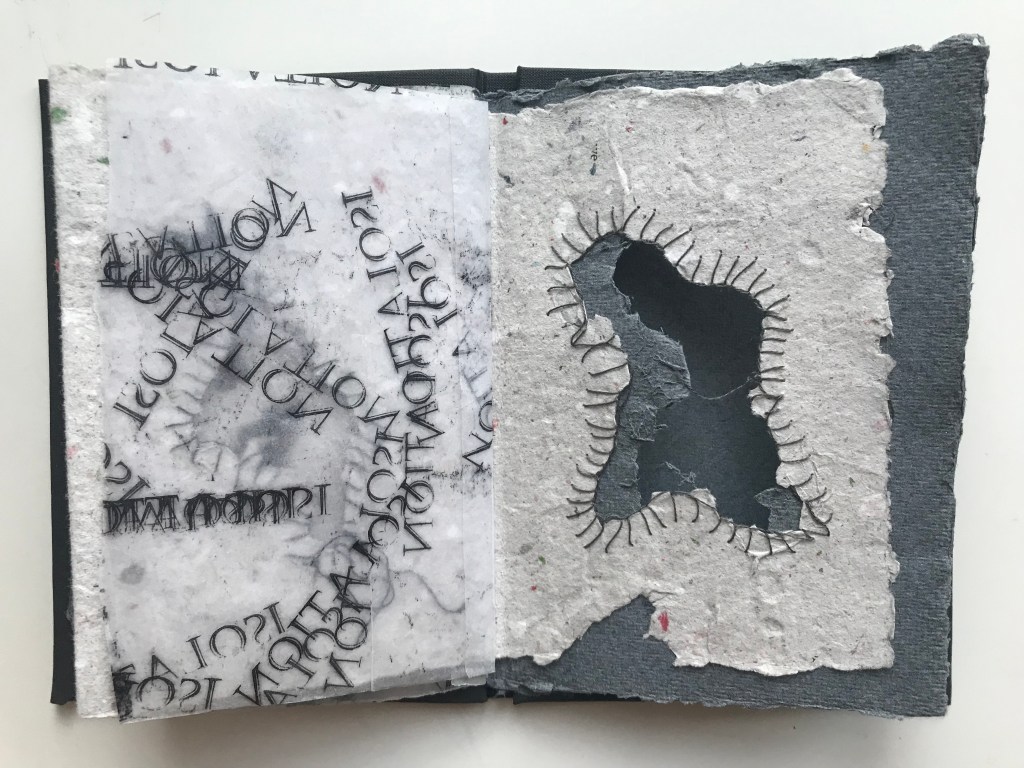
I am very much looking Forward to moving into the final major project, although i do not know the exact themes I want to explore I know that i want to continue to make artist books that explore the sensual side of touch, sound, sight in order to create a book that becomes extremely personal to each and every viewer in a different way with how they interact and travel through the book in order to read it.

This project has also been helpful in expanding and honing my skill set and focus it on the material qualities and use of paper as medium. The turning point for me was when I had the discussion with Doreen, this really helped me to discuss my ideas and how other practitioners explore bookbinding with print and how it is best for me to move Forward into the next project with research. I now feel more equipped to progress into the final major project with the intentions and experimentation to know what works and is effective and what doesn’t as well as knowing what to avoid!

Design a site like this with WordPress.com
Get started