LOCUS PROJECT: CONCLUSION

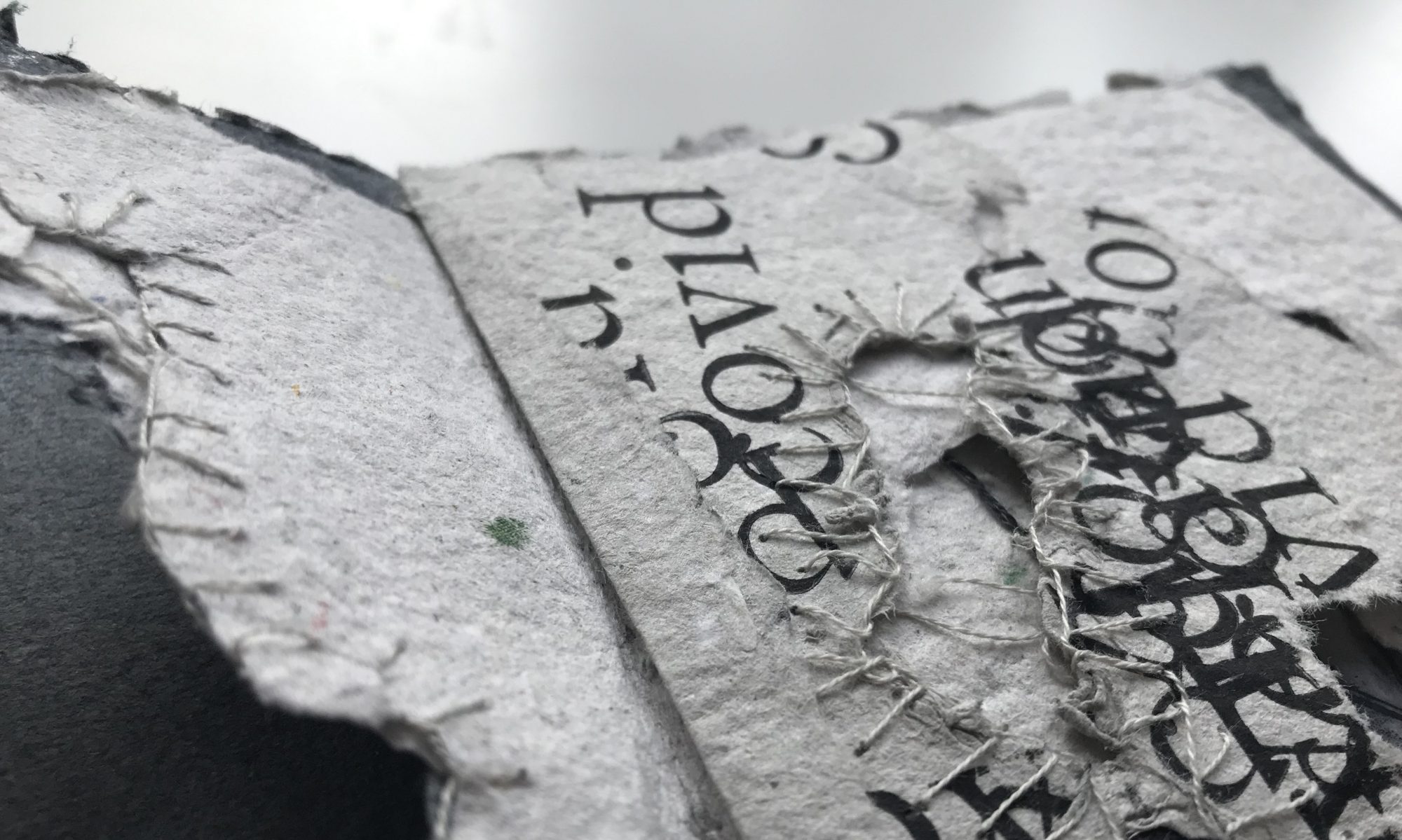
I am pleased with my overall achievements with this project, I feel as if I have a well rounded portfolio of flowing work and I have enjoyed conducting my experiments during this period of time. looking back on my work I feel my work became dormant during the middle, whilst I had this hiccup it was quickly resolved when I reviewed my previous work and explored a new direction with my project (this was when I introduced the clay forms) from then I started to get excited with the possibilities and enjoyed the forms I was producing.

If I could go back and improve any part of my work, I feel I could have been more explorative with the ways I exaggerated and distorted the balloons and could have also considered alternative materials and methods. I also feel if I had perfected the plaster method earlier and I had more time to explore this I would have experimented with slip casting my plaster forms.

I now believe the careful consideration of context within my work has helped me to produce meaningful outcomes considering the appropriate use of materials and methods to conduct my work and create forms that explore this context. Focusing my work on the phobia and juxtaposition of textures has allowed me to form an understanding of sensory feelings to cause reactions.

I feel I can now locate my work within an artistic field as these forms are very conceptual and although they have been designed to look the way they do, they are ultimately sculptural pieces that have been to be placed within a gallery setting.
LOCUS PROJECT: MY FINAL FORMS

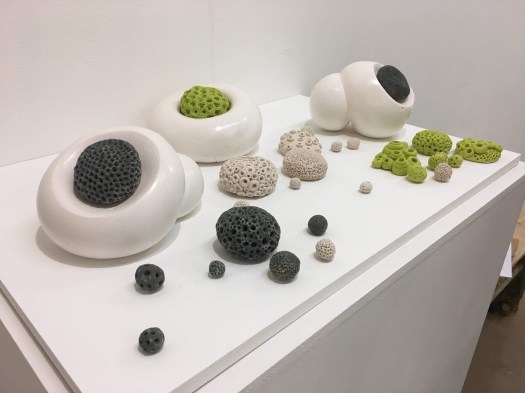
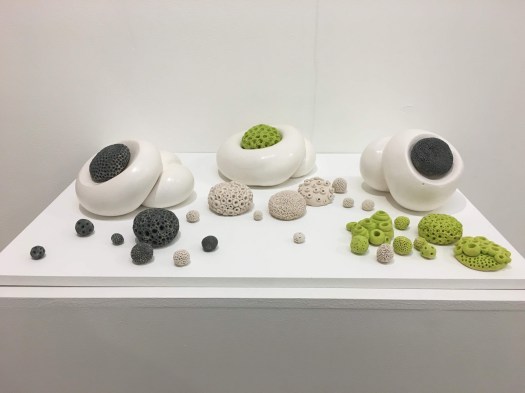
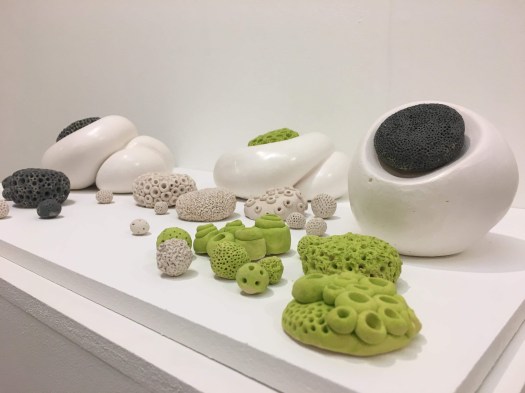
I decided to arrange my three final forms alongside the ceramic forms, this was a decision I made to mimic the hole textures found in nature (As a result of my research into Trypophobia), I decided on having them organically arranged as I felt when I composed them into a line they felt very clinical and I found the effect was lost. Combining the various sizes I feel add’s to the interest as well as the colours that complement each other well.

image1 (1)image2 (1)image3 (1)

LOCUS PROJECT: GLAZING MY CERAMICS AND ORGANIZING MY FIRING

This is similar to how my pieces will look once fired, I need to fire my work at around 1000°c to 1250°c as I am using White St Thomas clay and underglaze. I am attending the kiln meeting tomorrow to organise a space in the kiln to fire my work. I used both lime green and grey and have three unglazed forms, this is to allow for uncertainty during firing and will allow me to pick my prefered forms.

These will be matte once fired, i’ve decided to do this as I am interested in making a contrast between the shiny polished plaster and the matte ceramics, this also adheres to the sensory athetic of my work. creating an interest between the forms and space.


LOCUS PROJECT: DECIDING ON COLOURED UNDERGLAZE, TO GLAZE OR NOT TO GLAZE

Talking to a peer in ceramics, they have advised the best finishes for my forms would be to apply a shop bought underglaze to the surface using a brush, this has benefits as it allows me to undergo the process faster, as well as guaranteeing a good finish. The pigments in the mixed glazes are also brighter.

I am keen on the pink green and grey underglazes, one applied and fired these will be matte, this is an interesting option for me as it will compliment the juxtaposition in my work and should make the forms stand out form one another considering the plaster is polished. furthermore if i where to decide I wanted them to have a sheen I could apply a transparent glaze to the surface.

LOCUS PROJECT: POLISHING THE FINAL FORMS

Polishing the forms has been a long winded job, I am pleased with the results. Using shoe polish and polishing on and polishing off I have gained a smooth polished shiny surface too my work, which when combined with the ceramics creates a really visually pleasing form.  Although due to hand sanding and smoothing each by hand I have gained the best surface possible, this I am a little disappointed with as it is not as flush as I would have hoped.  I still feel pleased with the outcomes none the less.

IMG_7017IMG_7018IMG_7014

LOSCUS PROJECT: HOLES AND SENSATIONS

The fear of holes, known as trypophobia has been an inspiration behind the context of my work as a result of its trigger effects on the senses as well as the reaction caused by the textures. using the ceramics within my work has triggered this phobic response with people I have shown.

This response is interesting as the understanding and current research into the phobia is limited and has some connections to fear and anxiety similar to that caused by dangerous animals. Understandably this fear of a cluster of holes may trigger similar  reactions to that of a snake for its skin for example. As this is a common shape seen within nature for example, honeycomb, coral, sea sponge, animal skin and seed pods, it correlates similarly to the fear as the textures in these formation creates the same sensation. therefore my ceramic forms may produce this similar sensation as they are similar to those listed above.

Trypophobia Coral 2

Trypophobic Tiger

Trypophobic Branch

Trypophobia Reference Website. (2019). Nature – Trypophobia Reference Website. [online] Available at: http://trypophobia.com/image-gallery/nature/ [Accessed 5 Jun. 2019].

LOCUS PROJECT: COMPOSING MY FINAL FORMS

I have been experimenting with the composition of my final forms and the clay forms that sit within them, I want to have a variety of types of holes to reflect my understanding and research into Trypophobia as well as continuing to challenge the idea of the juxtaposition of the smooth and textures surfaces working coherently.

I am still undecided with the clay forms currently as I like them in their raw bisque fired state. speaking to someone from ceramics, I was advised not to use a slip based colourant and to have a go with an underglaze first. I like the raw matte finish of the bisque fired clay but I feel it will be beneficial for me to experiment with the introduction of colour to my work then to reflect and decide on the finish I want for my pieces once they are fired. therefore I am going to experiment with underglaze as well as acrylic paints- I am doing this as I am concerned with using glazes I may loose some details within the the forms, so using acrylics may avoid this problem. we shall see.


LOCUS PROJECT: PLAYING WITH PROPORTION

As I have been making these plaster forms and carving them to a smooth rounded finish I have been considering the size of the clay forms to sit within the crevices. making them so they are proportionate to the space.

I wanted to explore this play on size to see if this change manipulates the overall outcome of the piece making it more effective or less. This is to emphasise the Trypophobia and juxtaposition.

I rather like these forms, although they are different to my previous experiment there is something intriguing about the way the plaster curves into the ceramic ball and the way the viewer would have to move closer to the piece to view the ceramics.

LOCUS PROJECT: EXPERIMENTING WITH FINISHES

To make my plaster forms feel more flush and finished, I have decided to experiment with different finishes for the surface. whilst I want to keep the smoothness from the sanding and buffing I also want to keep the white finish that plaster has. therefore I want to create polished looking surfaces for my final set of forms. experimenting with lacquer clear polish, clear boot polish and bees wax polish.

img_6961.jpg

The first section: lacquer spray, the second: boot polish and the third: bees wax polish.

Experimenting with these I have decided the finish that creates the best results when applied to plaster is the clear boot polish as this can be buffed on and of with a cloth leaving a polished surface ideal for what I want to create.

I found the lacquer spray didn’t sit on the surface of the plaster well and became patchy when applied. I also found the bees wax polish became waxy to the touch making its surface tricky to handle, making the shoe polish the ideal finish for the pieces.

Design a site like this with WordPress.com
Get started