
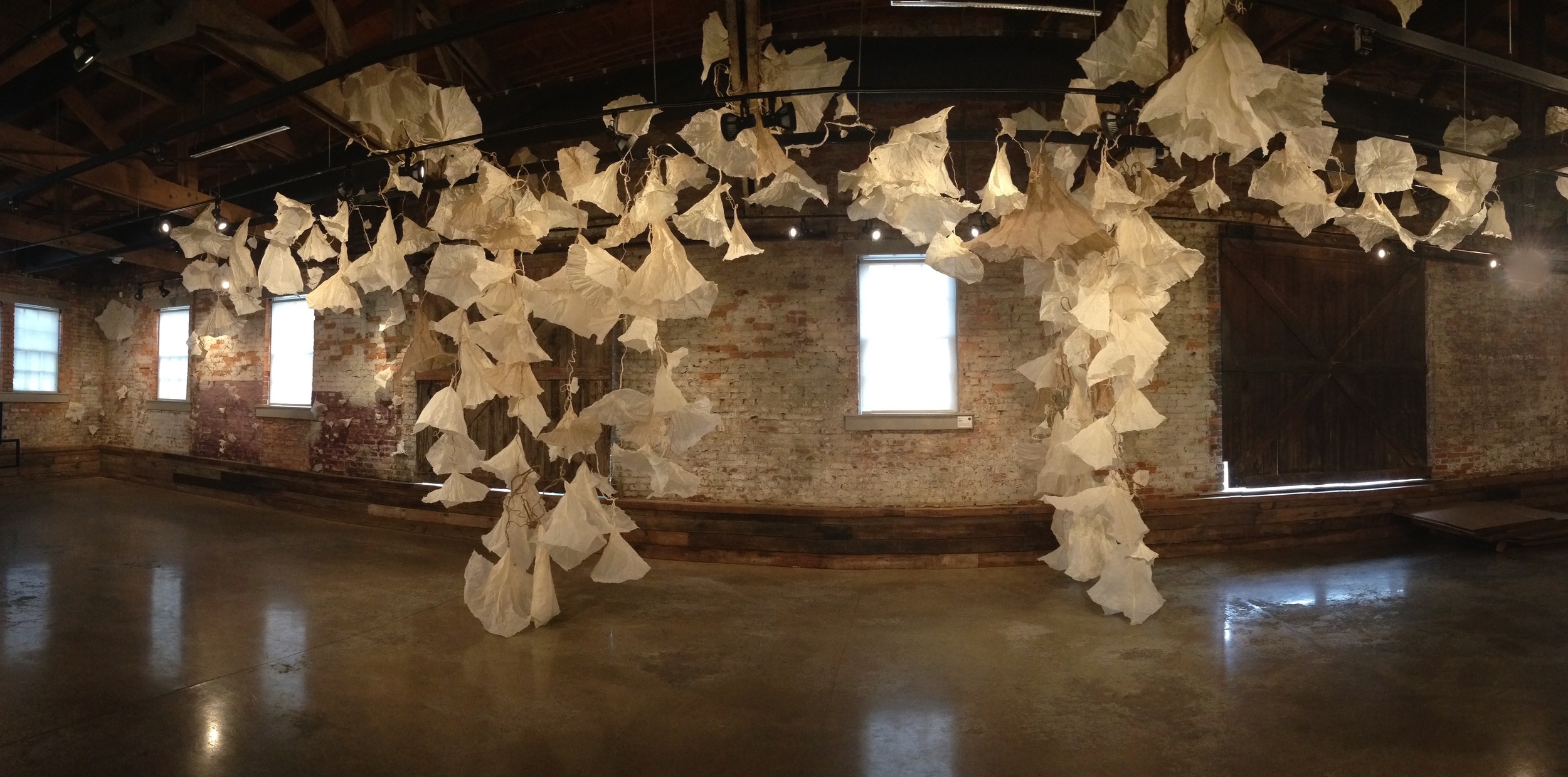
Peter Gentenaar is an intiallation based artist who works with paper to create large scale twisted structures that he creates using a bamboo frame as a vacuum in order for the handmade wet paper sheets to shrink over the forms to up to 40%.

His work creates interesting twists and distortions in the paper created by a controlled placement of paper and colour. These are inspired by vacuum process, the forms have subtle similarities to leaves, when they curl up as they dry. This is a completely natural process of drying where the forms start as 2D sheets and form into 3D forms as they dry.
This natural drying process is interesting for me and is something I have witnessed in my own work. It would be interesting to find out if it is the material choice of my hand made paper that causes this shrinkage, or if it occurs in all types of paper.

His work is both sculptural, featuring in galleries, as well as decorative and used in interior design.
Jocelyn Chateauvert makes paper sculptures from hand manipulation. Using abaca handmade abaca paper, She makes the papers and manipulates then in their wet stage once they have been pressed but not yet died. There is evidence of natural organisms being the inspiration for Chateauvert such as coral.
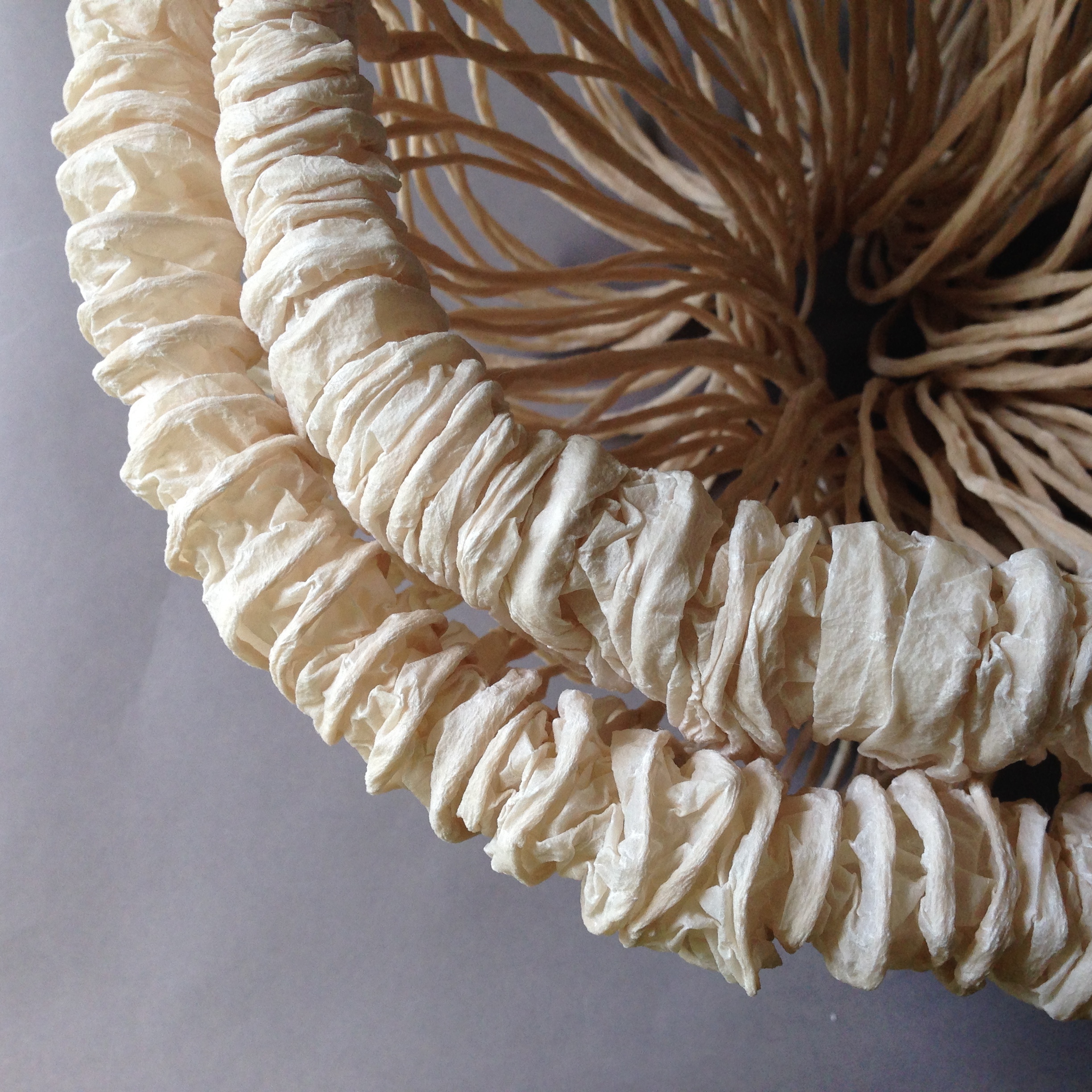


What makes her sculptures so successful is the textural and opaque qualities. there is enough strength in the tissue like paper to hold the forms but also the fragility creates a beautiful organic looking sculpture. I enjoy the way the sculptures interact and twist.
she works in paper constructions creating hanging, free standing and large scale work that can feature both in a contemporary gallery space and as installation work.
Chateauvert has inspired me to explore ways in which i can strengthen my own paper and give it rigidity and strength. I really enjoy the way the work is dyed, twisted and manipulated whilst wet, this is something i want to explore further when the abaca pulp I have ordered arrives. What astonishes me with this work is how no structural supports are used to hold the paper it bonds to itself whilst wet, I assume this is as a result of the fibrous material.
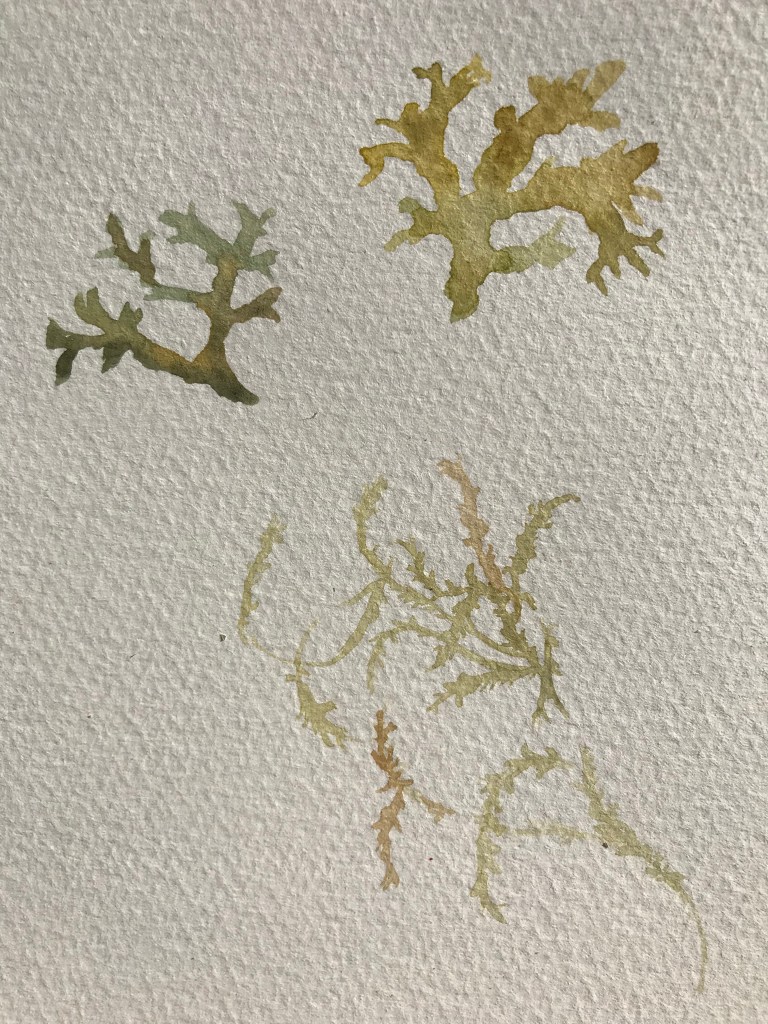
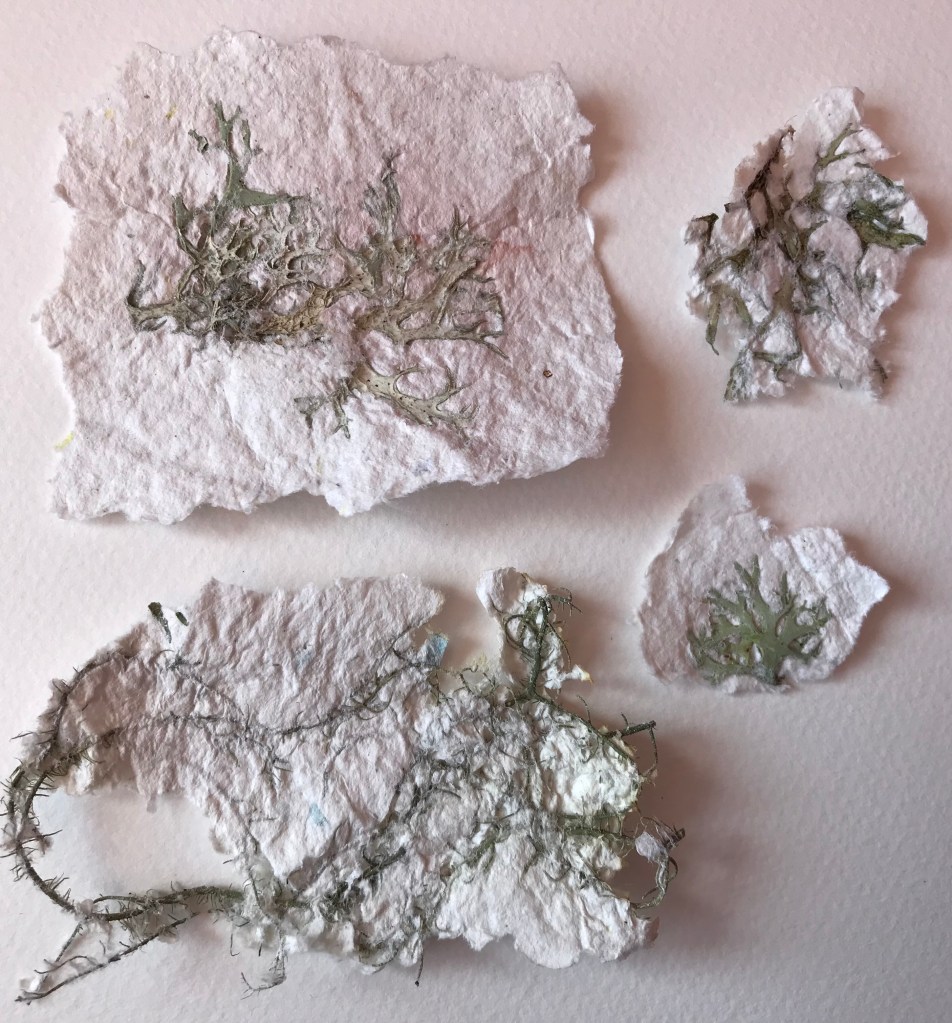
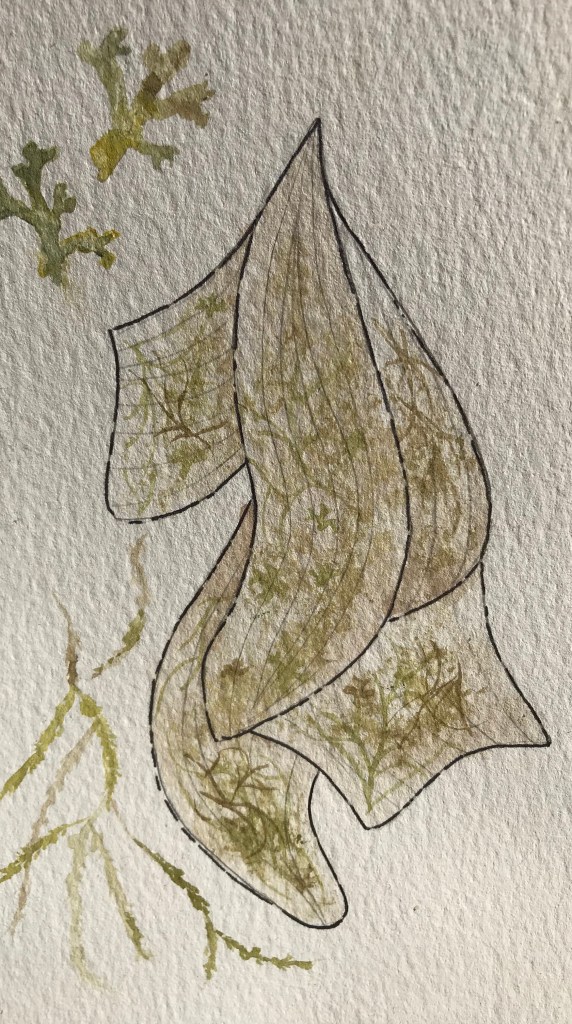
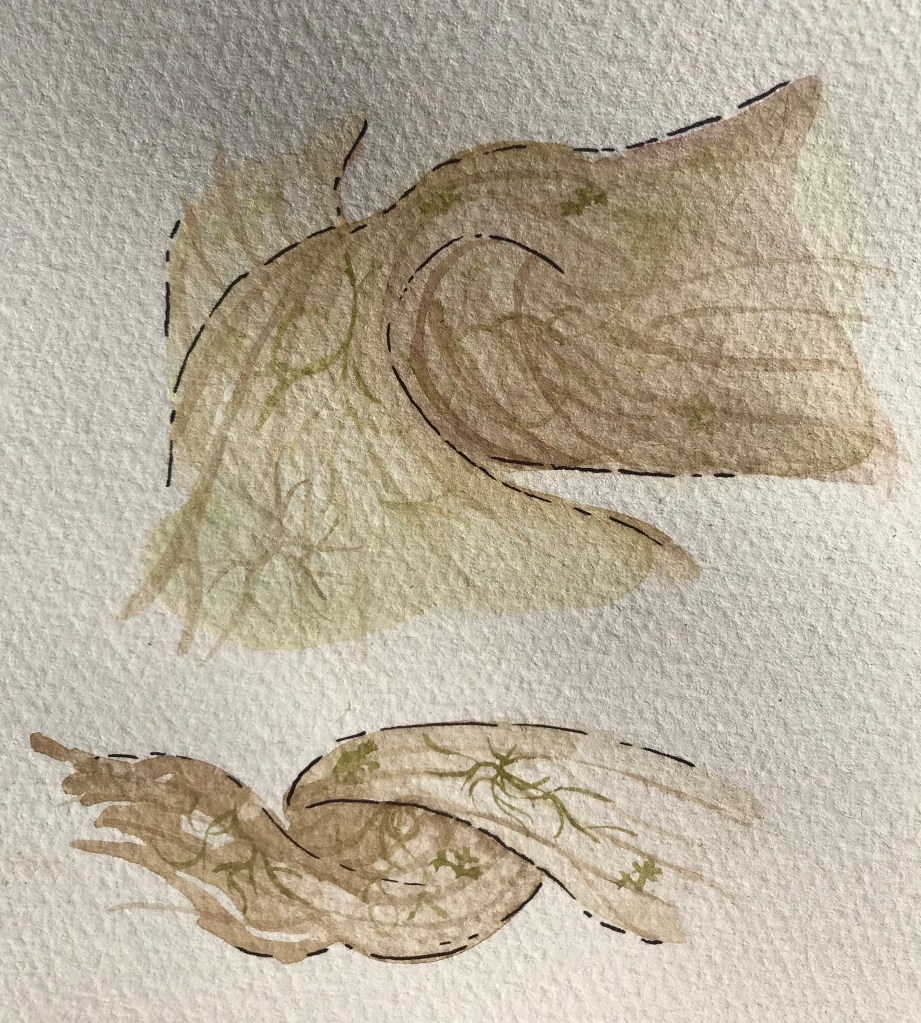
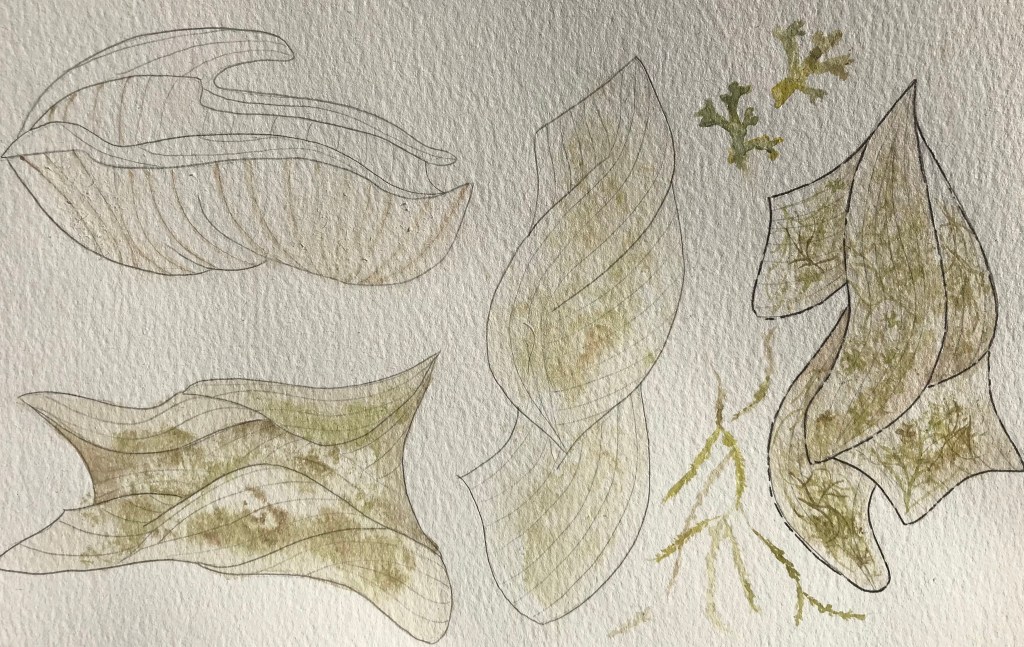
In reflection to advance my work into sculptural forms that hold their own weight I need to create some kind of support for them. By using wicker it will hopefully be able to create a frame that twists and curves much like the wood found in the New Forest. I am hoping I will then be able to college or lay my hand made paper over the frames. Whilst retaining the opaque qualities and fragility of the paper. By using licken I should be able to create some really interesting designs, that I will later be able to print and sew into.
I have ordered 1.4 mm wicker in the hope that I will be able to soak and manipulate it to create the structures I need. I have not yet decided whether these will be free standing of will hang.
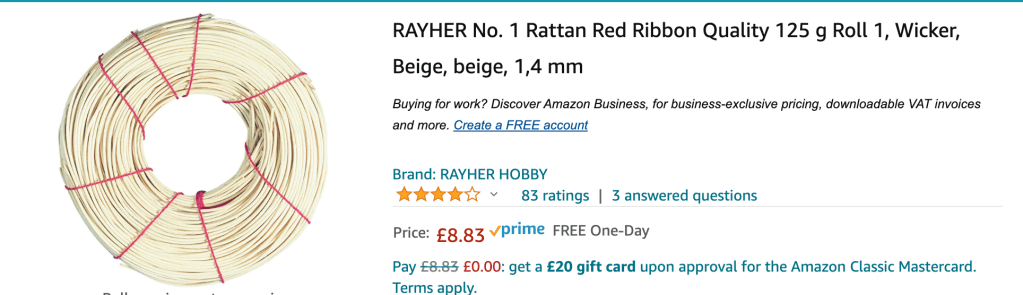
I would have liked to have got a material that was slightly more authentic but after purchasing the abaca pulp I have a bit of a tight budget, but I am hoping this will be adequate.
I like the idea of the inclusion or use of light to compliment the material qualities of the paper. I am not yet sure how this would work and whether it would transfer into a more commercialised lighting design or if I want this to purley be a sculptural form with light to highlight the shadows, opacity and natural materials.
I have decided to do this as an alternative to making and constructing (as I don’t have access to my book making materials). Although the skills, materials and techniques are very much transferable between the two and sit within the same reals. I am hoping that I will then be able to make a collection of artist books and paper forms that compliment each other.
After looking back at my artist research I found that many of the artists I have been looking at that manipulate and build with paper either make or use paper which have stronger fibrous qualities and contain fibre such as abaca and flax, these are natural fibres. Abaca is the fibre stripped from banana palms which is then processed and cooked and dried to form the fibre. This makes sense that the artists combine this material to give durability and strength. As well as retaining the opaque qualities I enjoy within paper.
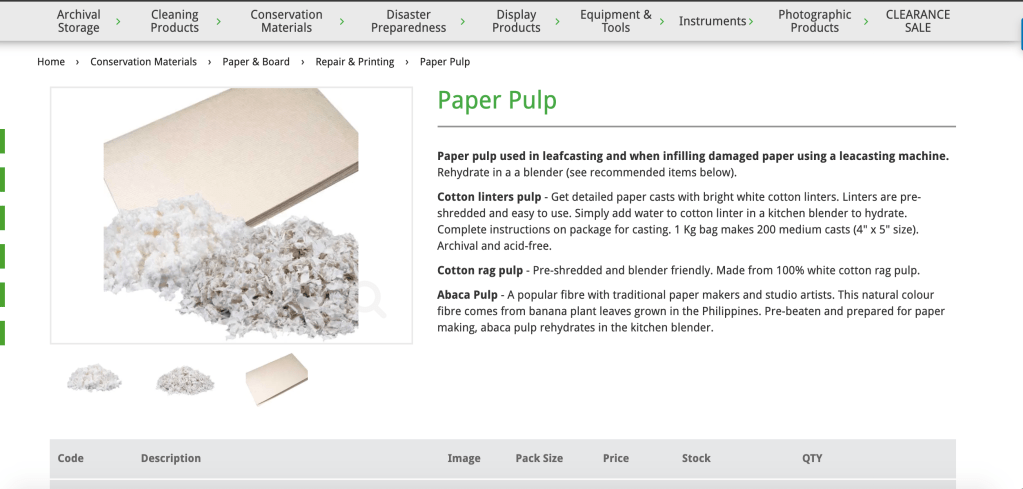
I wanted to give this material a go to see if this would make my paper more fibrous and strong. I am hoping I will be able to make thinner tissue like paper that has strength. After trolling through the Internet with not much luck locating uk based Abaca fibre. I came across a Norfolk based company that sell abaca pulp sheets (I was truly overjoyed!) which on the website state you blend and rehydrate accordingly and use like pulp. not only is this a traditional paper making material, it is also natural. I want to try and keep the man made material to a minimum although this is not always possible.
I reflected on the paper made previously and found that the I was struggling to manipulate and bend the paper made from recycled paper. This was because I was manipulating it into a shape once it had dried using a spray bottle of water( this almost disintegrated the paper, making it unworkable), the paper was extremely fragile and ripped as I was bending it.
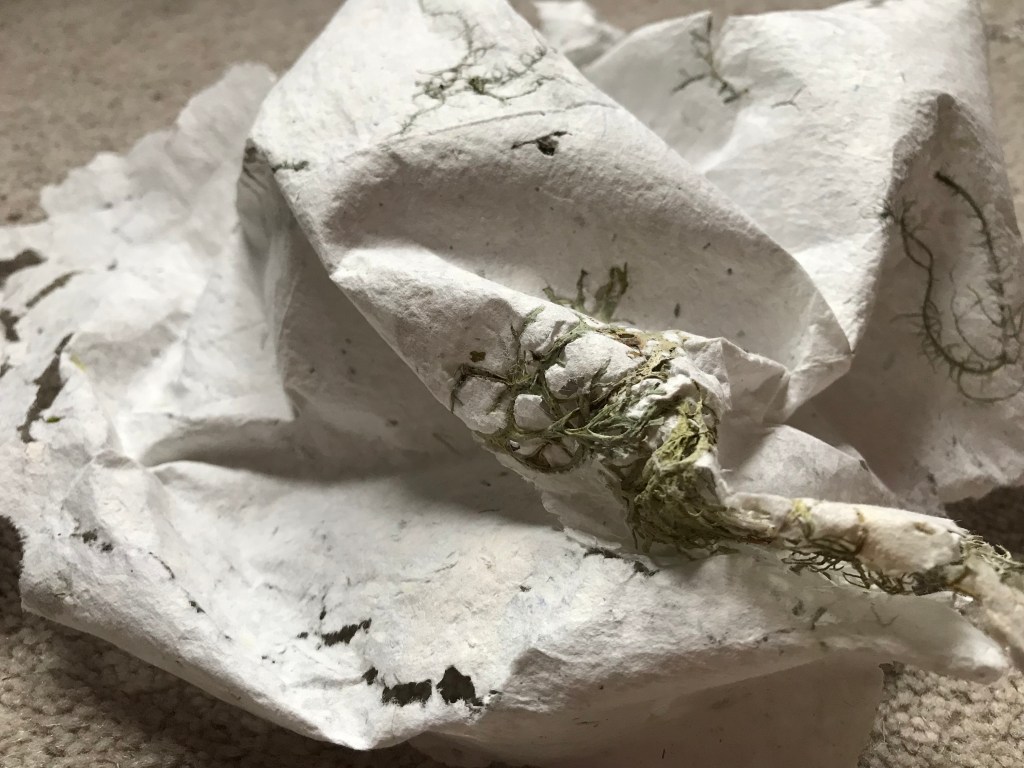
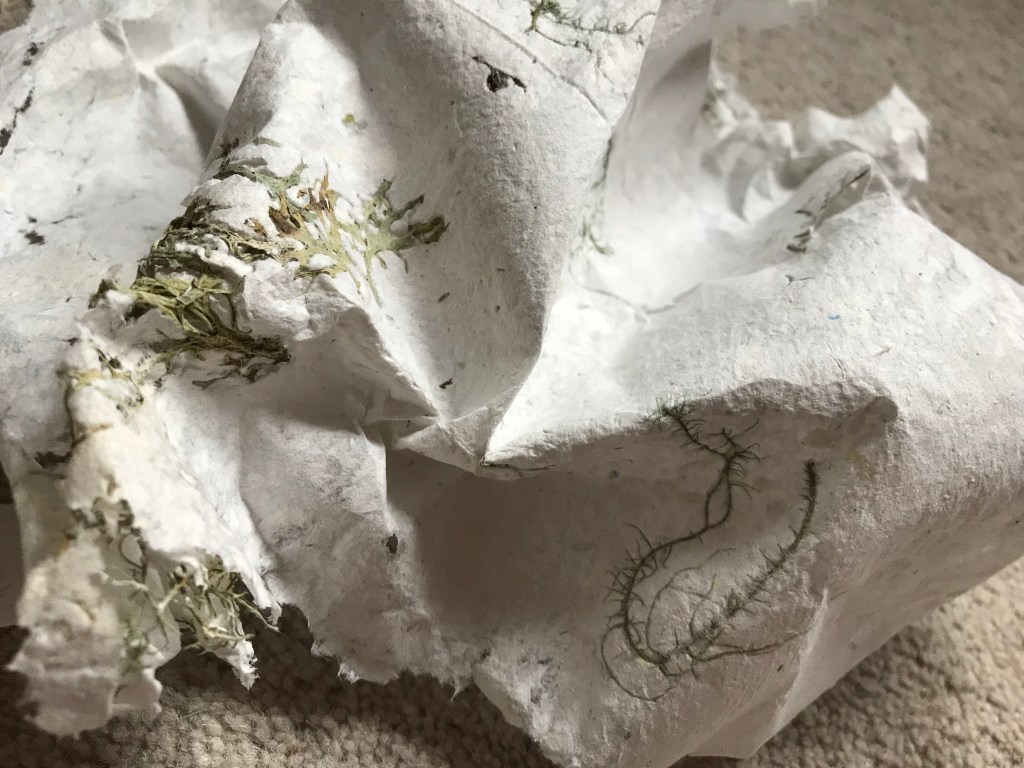
I decided I would change the way I was working and experiment with manipulating . I needed to improve the strength of the paper as well as the quality. I made the paper thicker initially and arranged the forms into a shape while they were wet. This seemed to work to hold the shapes but when I came to further manipulating and holding its own weight and the folds it struggled.
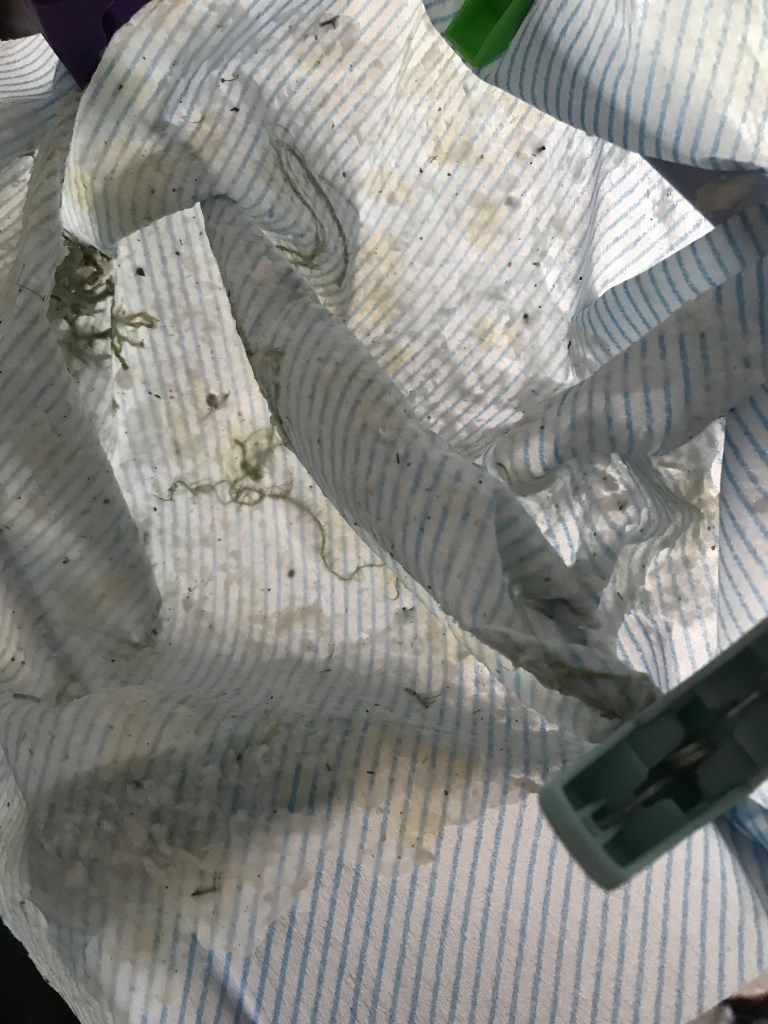
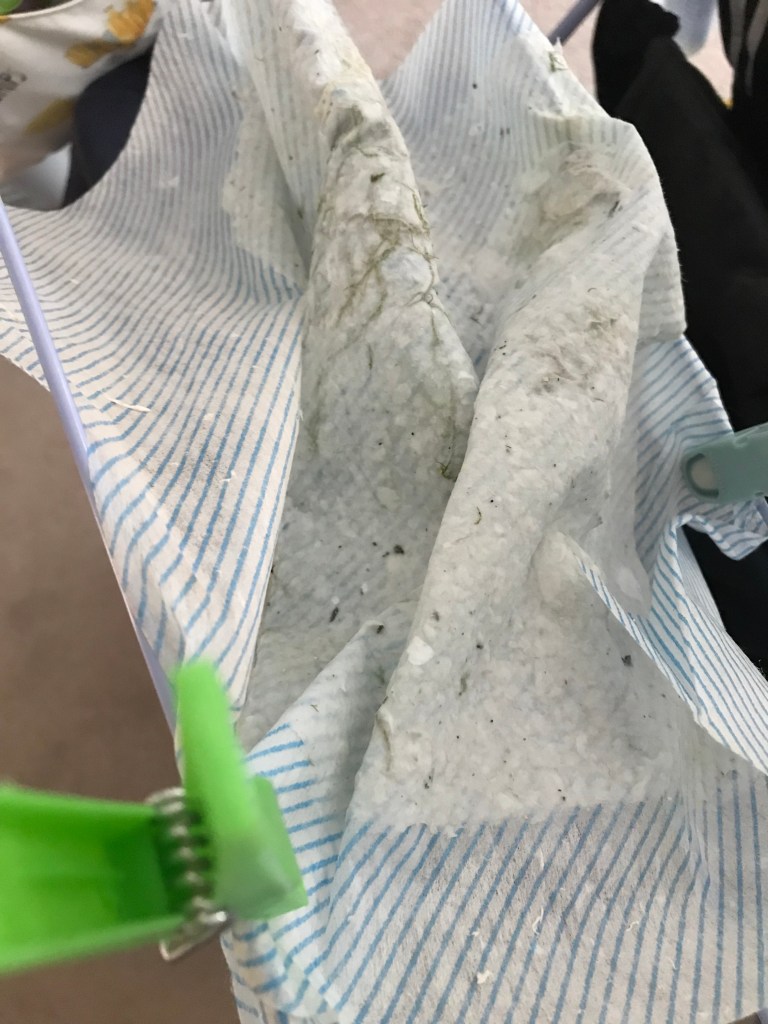
Although this was not very successful I enjoyed the way the folds created shadow and interest to the paper and how the lichen integrates into the paper. I want to continue to explore this but find a way to support the structures and strengthen the paper.
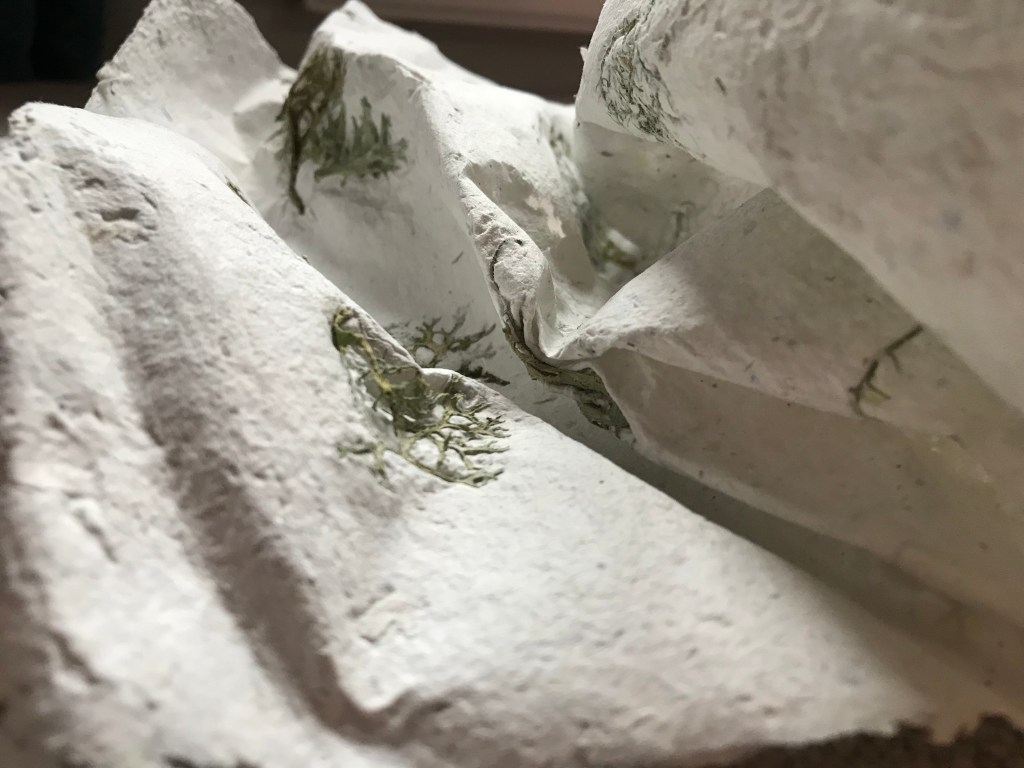
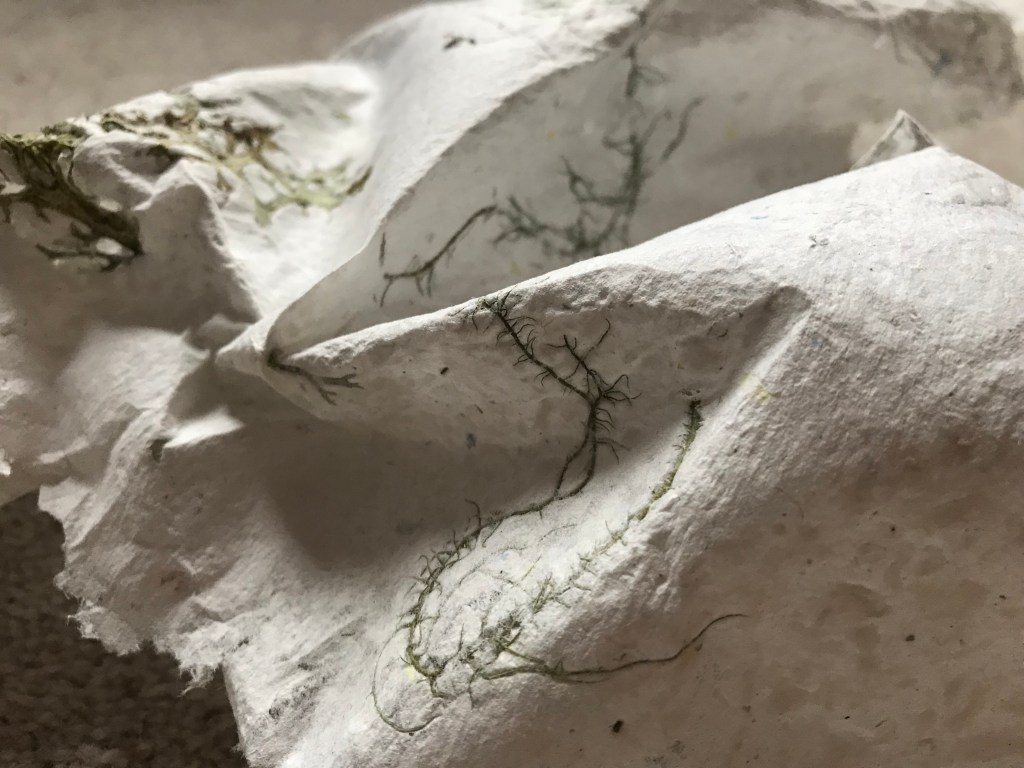
After researching various artists and book binders I have found many have supportive work that sits alongside their artist books. This is something that has caught my attention as I dont have the materials or access I need to sew and make books. This isn’t too far from my skill set rather focusing on the material of paper in an alternative way.
As a result, I have decided to focus on paper manipulation and construction (this was initially discussed with my 1:1 with Ingrid). Moving Forward I want to concentrate on the ways I can manipulate my cotton paper and further combine the lichen that I had foraged. I want to explore ways I can make a sculptural form with paper. How far I can push the paper and how I can support it as well as what form it takes. This will be something I will have to explore through trial and error.
As soon as I can have access to the materials, I am keen to make an artist book that sits alongside the sculptural pieces.
After looking at paper manipulation and construction artists who use a wide range of approaches to making and working with paper I wanted to decide on the best way to approach making paper, so that the material qualities (fragility, strength, fragmentation and opacity) I want to explore are used to make the most effective whole sheets of paper.
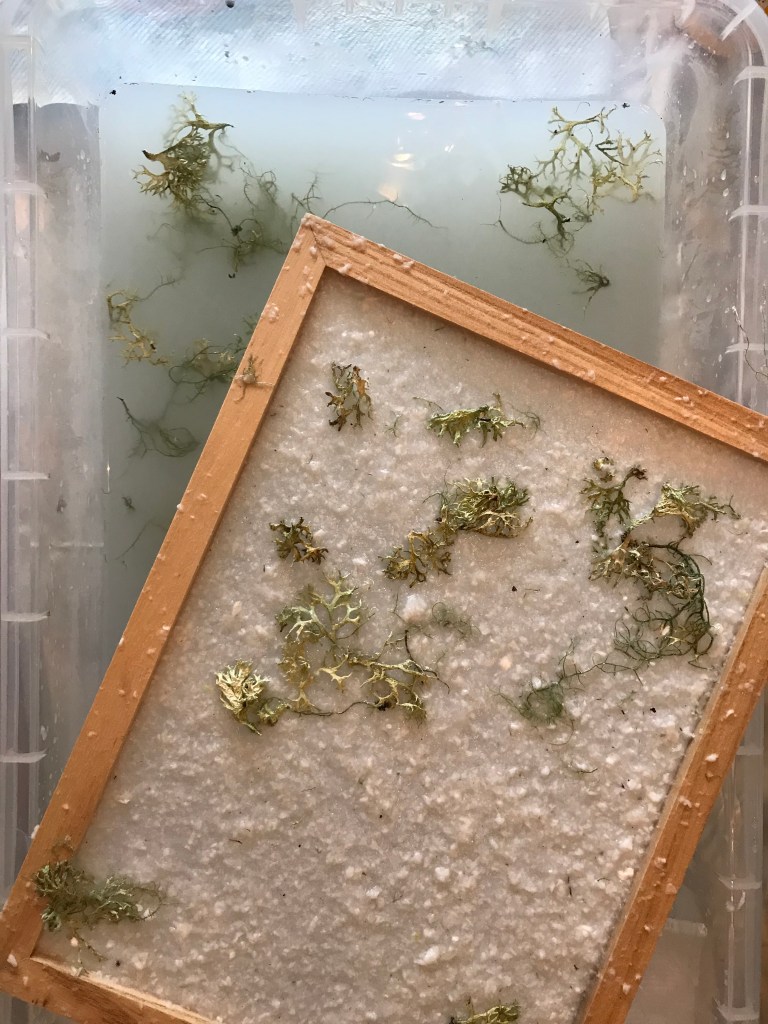
I found the trickiest part of making this paper was combining the the lichen ( fallen, that I had collected and dried from the New Forest) so that it retained its structure but also spread evenly and interestingly across the paper. I attempted a variety of approaches to do so.
The least successful was placing the lichen onto the paper once I had formed the paper sheet, this was because the licken was not embedded enough into the paper and tended to spring out, furthermore this was a very controlled way of making the paper and I would prefer this stage of paper making to be more natural and unpredictable. I had also tried to control the paper pulp much like a paper mache medium and layering the lichen between the pulp, this was successful to get lichen that dangled from the paper but the down side to this was that the paper was too thick and had lost its opacity and became too ridged to manipulate.
The most successful approach was to submerge the licken into the paper pulp and as I drew the frames to the surface the lichen formed a more natural pattern embedded within the paper that had the fragility and opacity that I wanted.
Moving Forward I want to explore ways of creating tone with the paper and colouring the pulp to create more interest around the lichen (to see if this would add or subtract from the natural patterns) and start to manipulate the pages by bending curving and folding to see how far I can push the paper until its fragility gives in. As well as this I want to start to bring in another stitch element into the paper to exaggerate some of the manipulation as well as mimic the lichen.
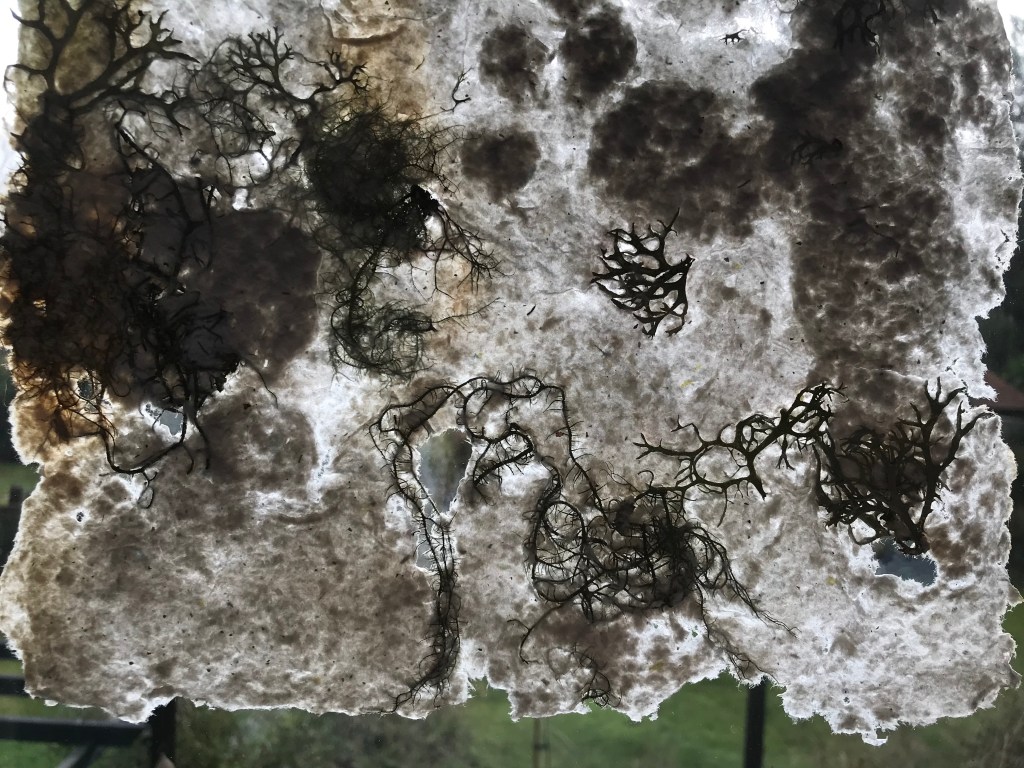
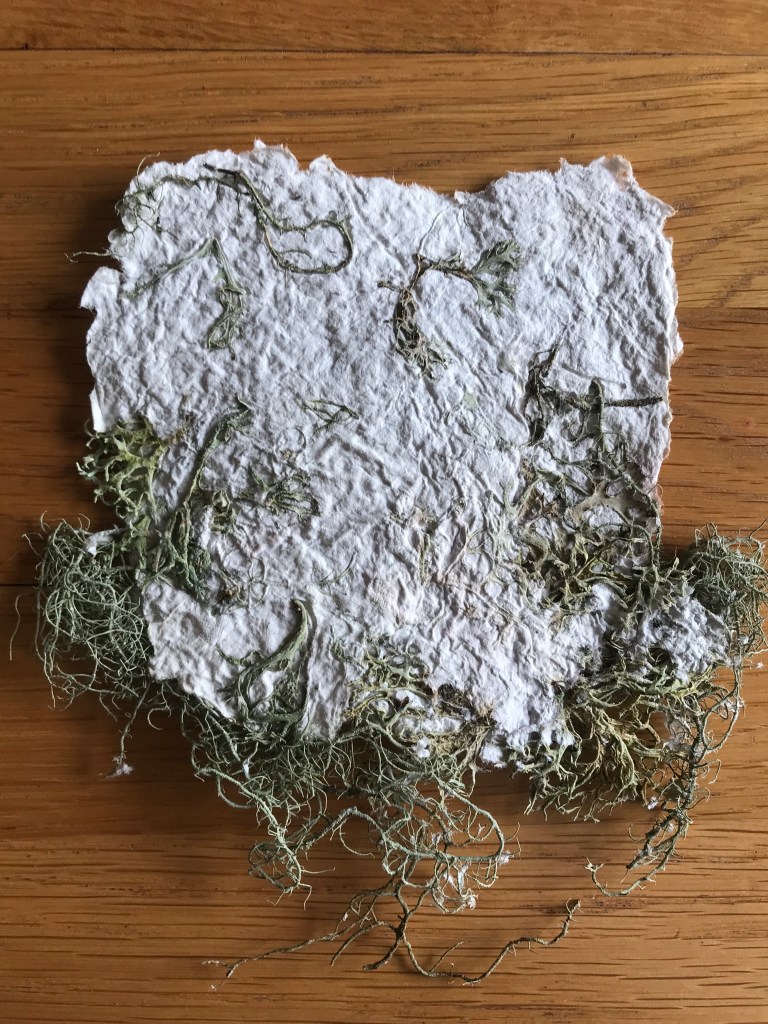
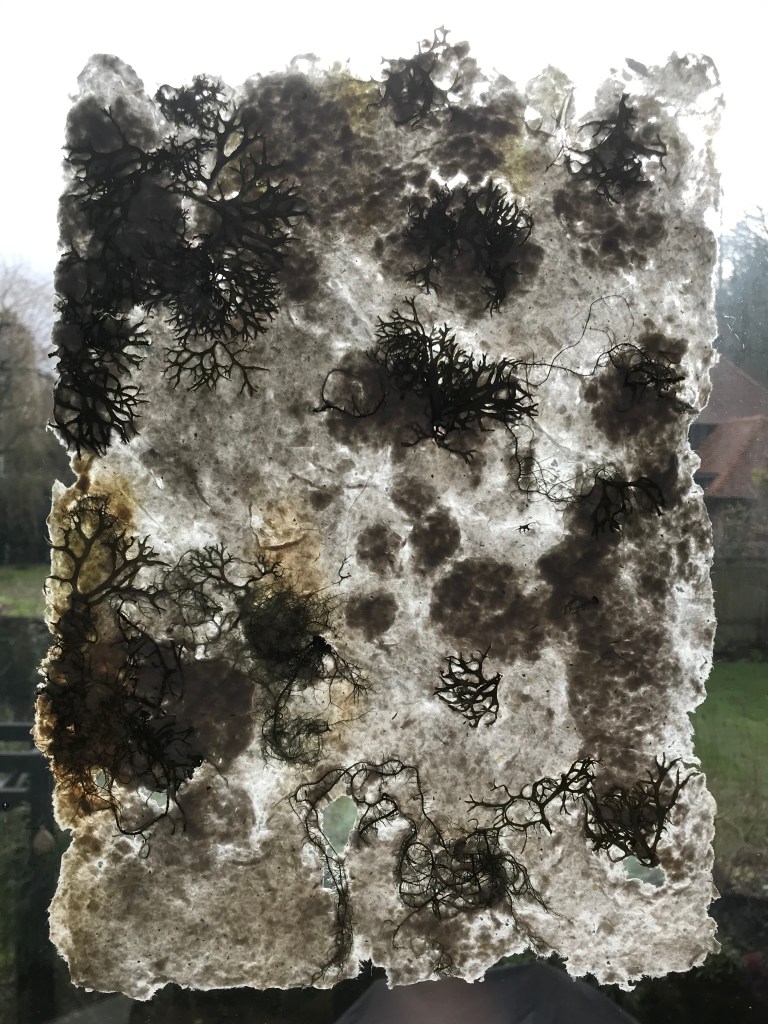
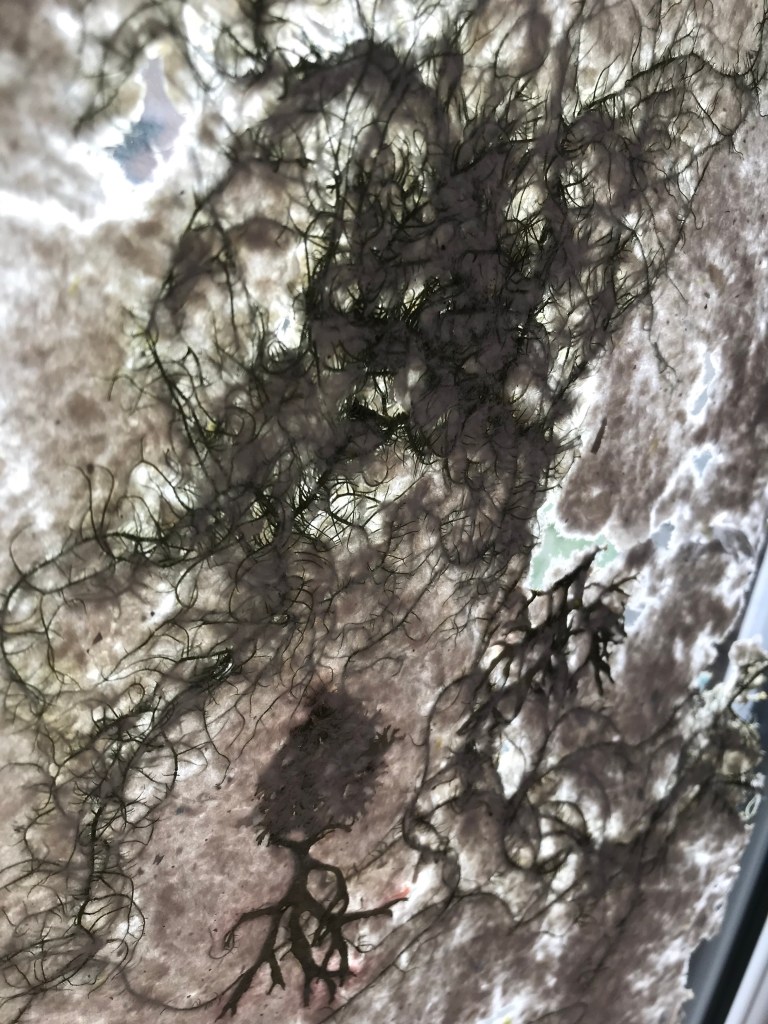
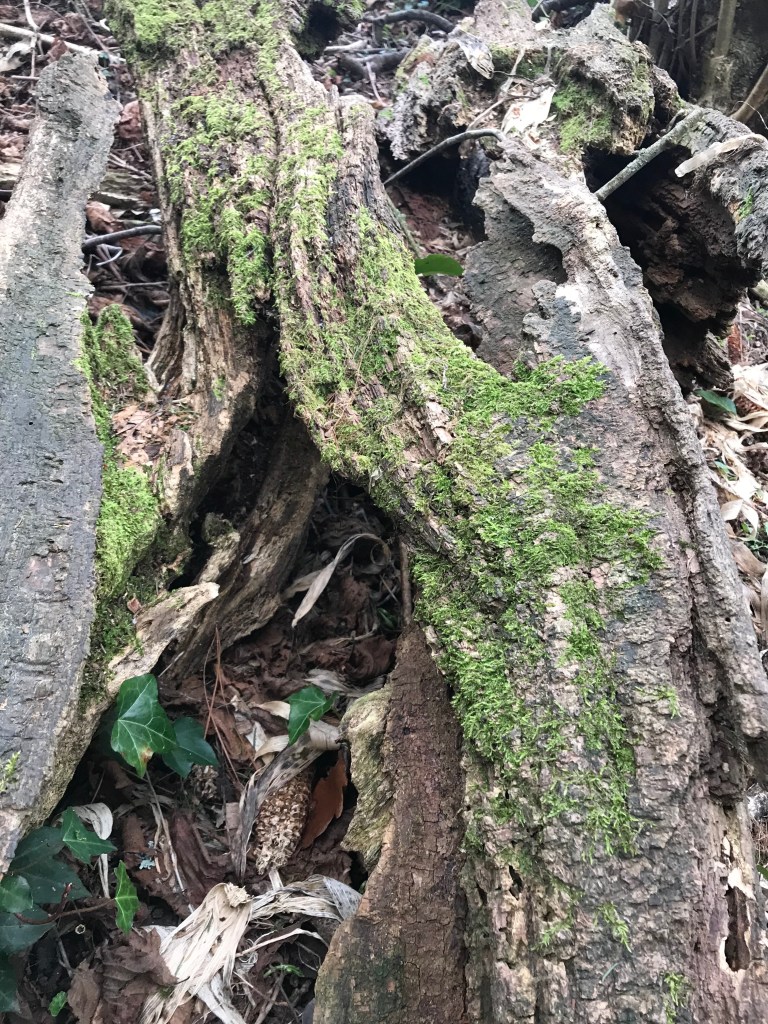
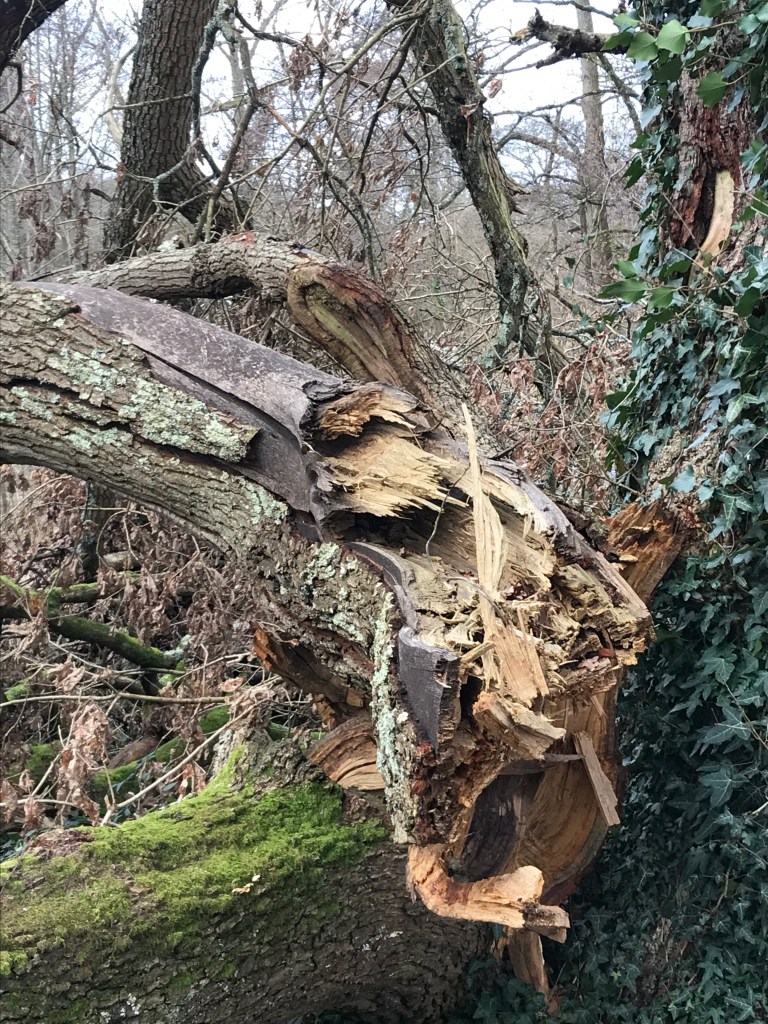
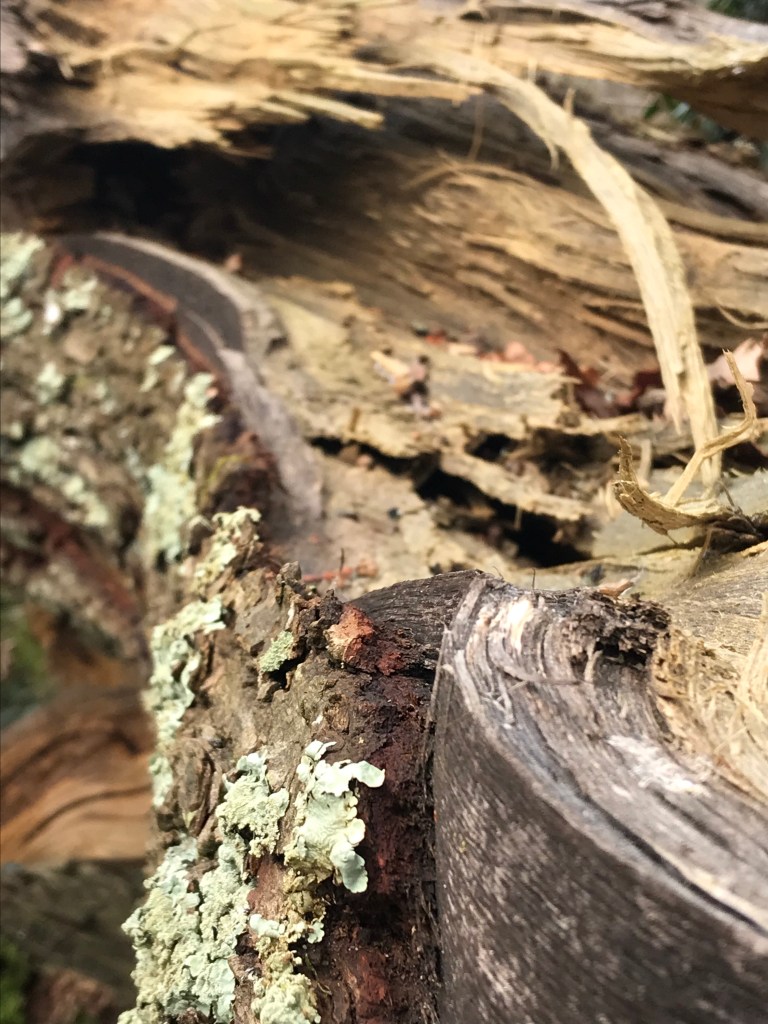
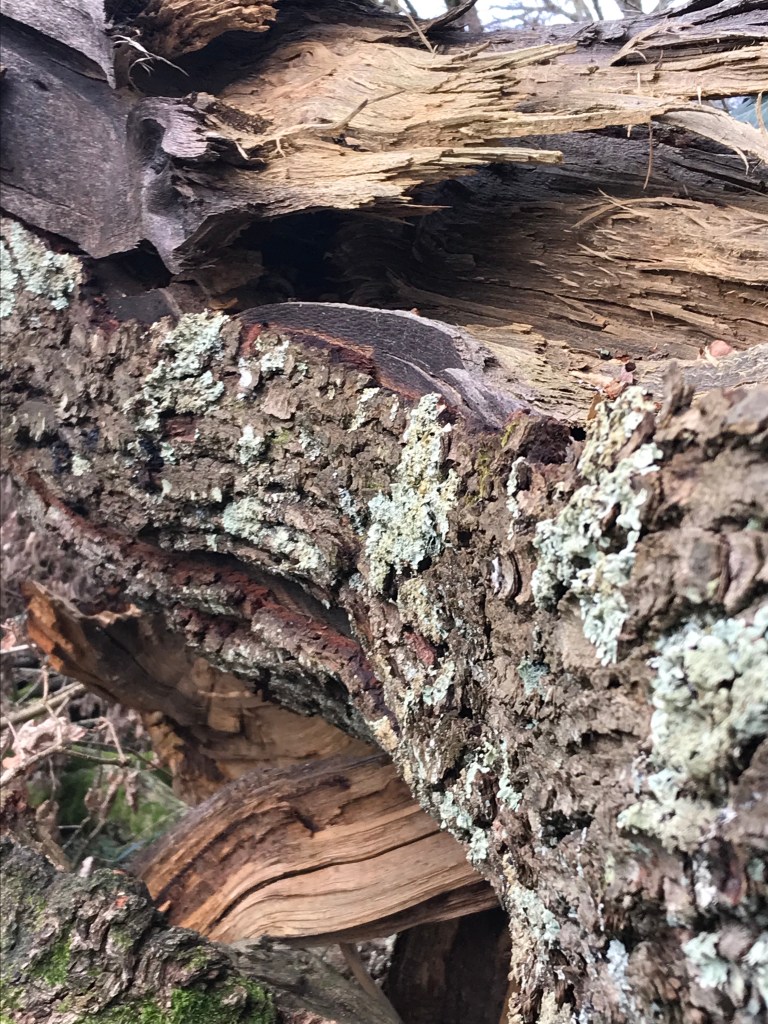
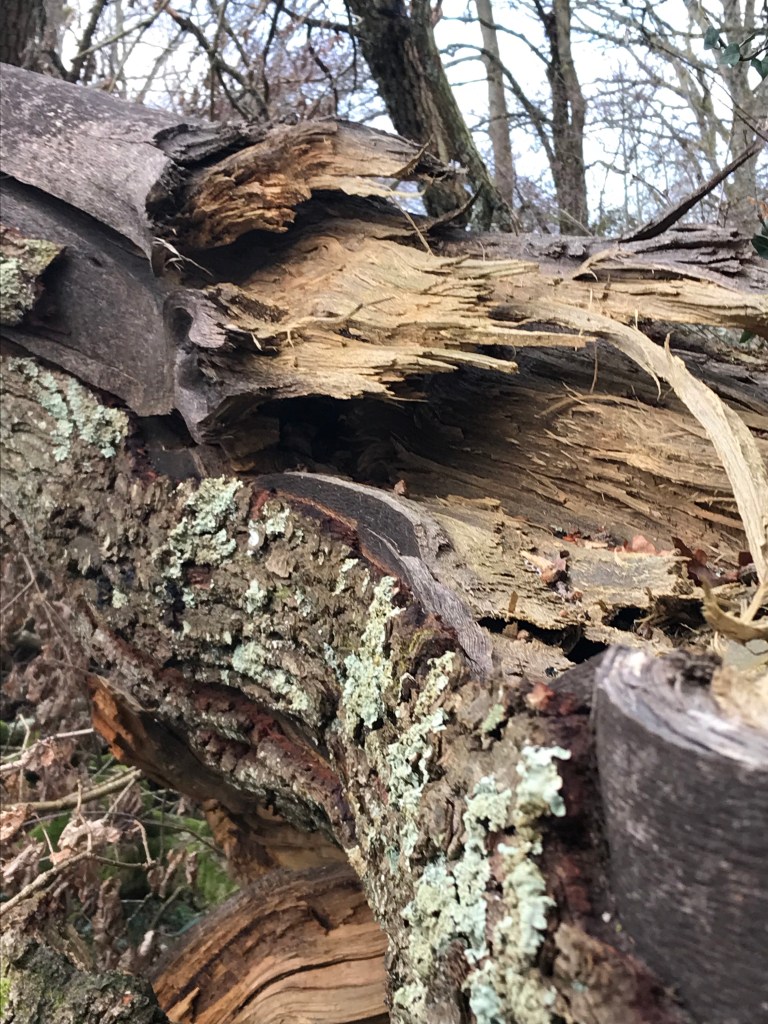
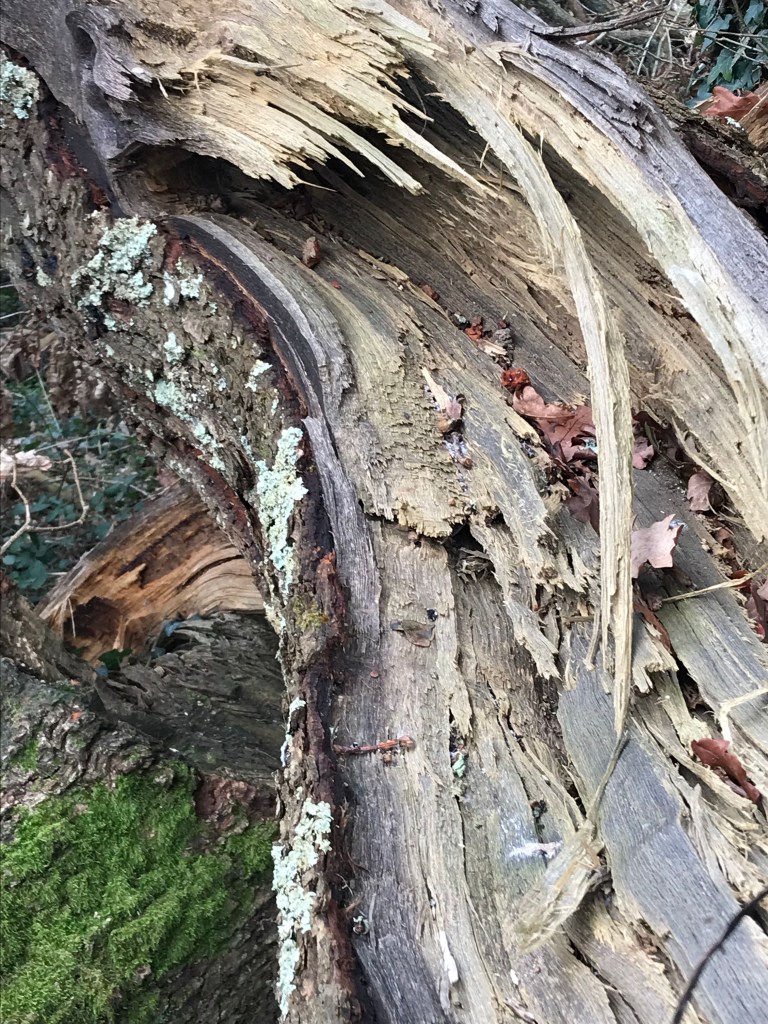
I live extremely locally to the New Forest, I wanted to use as locally sourced or natural materials as I could to experiment with (where I can) in order to make paper. I have previously used Lichen in paper and the results were extremely successful. This material interested me for its geographical locality as well as its natural and interesting appearance. These are also indicators of pollutants and grows extremely successfully within the forest because of its low pollutant levels. The lichen grows on the trees making them look hairy in some cases. I only picked licken off the floor or dead wood that had fallen of the trees. I brought them home dried them out and separated them. Moving Forward, I will combine these with my paper making.


 Lara Hoad Artist Designer: Maker