MOON RESEARCH: MYTHS AND SCIENCE

“On July 16, 1969, astronauts Neil Armstrong, Buzz Aldrin and Michael Collins lifted off from Launch Pad 39A at NASA’s Kennedy Space Centre in Florida on a journey to the Moon and into history. Four days later, while Collins orbited the Moon in the command module, Armstrong and Aldrin landed Apollo 11’s lunar module, Eagle, on the Moon’s Sea of Tranquillity, becoming the first humans to set foot on the lunar surface.”

NASA. (2019). NASA Celebrates 50th Anniversary of Historic Moon Landing. [online] Available at: https://www.nasa.gov/press-release/nasa-celebrates-50th-anniversary-of-historic-moon-landing-with-live-tv-broadcast [Accessed 14 Oct. 2019].

The man in the moon origins:
The man in the moon scars (that is seen on the surface of the moon) were created by asteroids that crashed through the surface of the moon, triggering volcanic bulges. This can be seen by the dark patches on the moon’s surface, which are called “lunar seas”, that most notably forms the moons recognisable face, known as “the man in the moon” (pictured below).

Picture 1.png

En.wikipedia.org. (2019). Man in the Moon. [online] Available at: https://en.wikipedia.org/wiki/Man_in_the_Moon [Accessed 14 Oct. 2019].

Historic Myths of the man in the moon:
Tecciztecatl:
A male Anzac god associated with Asian culture
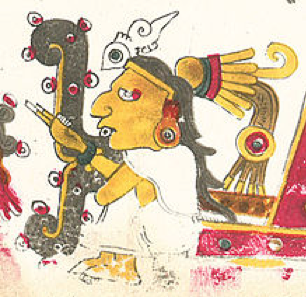
Picture 2

En.wikipedia.org. (2019). Tēcciztēcatl. [online] Available at: https://en.wikipedia.org/wiki/T%C4%93ccizt%C4%93catl [Accessed 14 Oct. 2019].
Selene/Luna:
A Greek goddess in roman mythology, paired with the god of the sun. She takes care of the moon at night as he takes care of the sun during the day.

Picture 3.png

En.wikipedia.org. (2019). Luna (goddess). [online] Available at: https://en.wikipedia.org/wiki/Luna_(goddess) [Accessed 14 Oct. 2019].

The God of Drunkards:
A medieval belief of a man held in the moon with a taste for claret. The man in the moon is also named within early English nursery rhymes.

BAM’S MEDAL PROJECT: CLAY OUTCOMES

Exploring this brief and the concept of an artistic medal I have chosen to commemorate the 50th year since the moon landings. to celebrate this my concept for my medal is a two sided contrasting piece that recognises the jump in scientific research and development by comparing pre and post landings.

Medal ideas, Inspiration and context:
I wanted to represent the moon by juxtaposing two beliefs of the moon on each side of the medal. For the front of the medal, I will portray the historical understandings of the moon (exploring the moon’s relation in mythology and anthropology). For the reverse side of the medal, I will represent the moon’s surface and crater-filled texture, to artistically signify the advancements in human technologies that have allowed the moon’s surface to be revealed in great detail. The two sides will create a visual contrast between the portrayal of the moon through stories and myths, and the reality of the formation of the moon created by asteroids. This is to explore the relation of the human established beliefs of the moon (pre landings), and the contrasting scientific understandings of the moon (post landings). I am exploring this to celebrate the 50th year anniversary of the moon landings, celebrated in 2019.

TRIP: ROYAL MINT

I have decided to pick the BAMS project for my brief, this trip was particularly useful for me as I have gained knowledge of how the mass production of coins is created but also how the designers create the designs large scale by hand carving the details in order to reproduce on a smaller scale.

it was fascinating seeing the massive scale of the production and the mint condition when first created.

i think it is important for me to consider the reproduction of my medal to insure I get consistency between my mock ups and my final bronze forms.


TRIP: ST FAGANS

I found this trip particularly interesting, being shown the archives and the collections allowed me to think about possibilities and consider traditional techniques within my work that I could use as part of my chosen briefs.

The carving techniques in particular used as traditional love spoons and butter presses inspired me most. wood carving is a technique I would like to pursue with during my time at uni.

At current I feel I am going to pursue the BAMS project but this trip was still of use to me and I enjoyed looking at the collections.

EVALUATING THE BRIEFS: BAMS, PEWTER LIVE, MADE, LIBRARY BOOK BRIEF, CRAFT IN THE BAY.

British Art Medal Society:
This brief explores the concept as a medal as a piece of art. this exited me as the traditional concept of a medal is to be round, where as with this live brief there is an opportunity for the medal to be more fluid and aesthetic.
thinking of possible themes I considered the 50TH anniversary on the moon landing, this has many opportunities to explore surface and design. I am also keen on exploring the casting process of bronze and learning a technique that is new to me.

Pewter live:
This brief explores the possibilities with making and casting using pewter, this is a technique I have used before but would enjoy exploring in more depth. I have considered endangered frog and toad species as a theme for a decorative object as I am interested in the surfaces and pewter casting would be a useful way to portray this.

Library book brief:
This brief explores the potentials of book making and construction as a piece of art, this brief learns the techniques involved in book production and I would explore related techniques. In terms of a theme for this brief I would be interested in the use of origami and chinese sewing books.

St Fagans:
Referencing tradition, for this brief it’s about looking at the old and the new and having an historical reference to traditional objects or techniques.

Craft in the bay:
This brief explores the involvement in curation experience and a show case, this would be an interesting thing to experience, although i have never considered this as a path I wish to pursue I think it’s a great opportunity although there are briefs I would rather explore.

MADE:
this is an opportunity to submit designs and ideas to be considered for production, for this I would consider making decorative objects that appeal as homeware objects. This is a great opportunity to get work out.


LOCUS PROJECT: CONCLUSION

I am pleased with my overall achievements with this project, I feel as if I have a well rounded portfolio of flowing work and I have enjoyed conducting my experiments during this period of time. looking back on my work I feel my work became dormant during the middle, whilst I had this hiccup it was quickly resolved when I reviewed my previous work and explored a new direction with my project (this was when I introduced the clay forms) from then I started to get excited with the possibilities and enjoyed the forms I was producing.

If I could go back and improve any part of my work, I feel I could have been more explorative with the ways I exaggerated and distorted the balloons and could have also considered alternative materials and methods. I also feel if I had perfected the plaster method earlier and I had more time to explore this I would have experimented with slip casting my plaster forms.

I now believe the careful consideration of context within my work has helped me to produce meaningful outcomes considering the appropriate use of materials and methods to conduct my work and create forms that explore this context. Focusing my work on the phobia and juxtaposition of textures has allowed me to form an understanding of sensory feelings to cause reactions.

I feel I can now locate my work within an artistic field as these forms are very conceptual and although they have been designed to look the way they do, they are ultimately sculptural pieces that have been to be placed within a gallery setting.

LOCUS PROJECT: MY FINAL FORMS

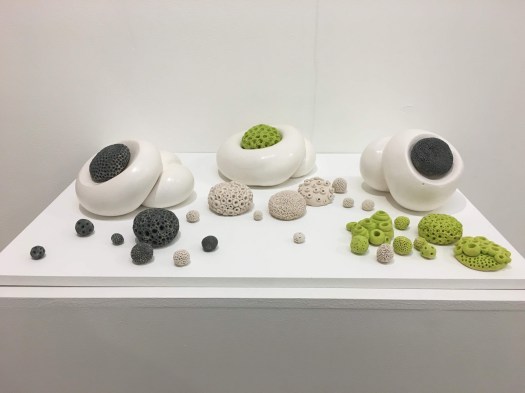
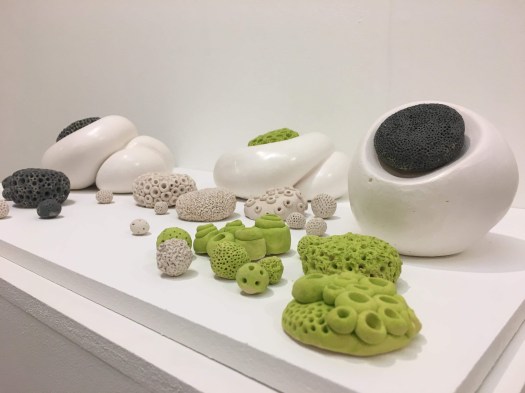
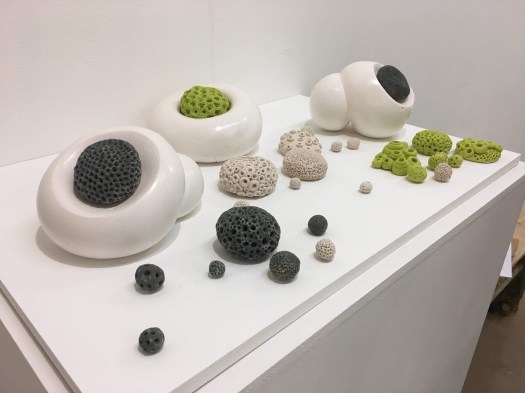
I decided to arrange my three final forms alongside the ceramic forms, this was a decision I made to mimic the hole textures found in nature (As a result of my research into Trypophobia), I decided on having them organically arranged as I felt when I composed them into a line they felt very clinical and I found the effect was lost. Combining the various sizes I feel add’s to the interest as well as the colours that complement each other well.

image1 (1)image2 (1)image3 (1)

LOCUS PROJECT: GLAZING MY CERAMICS AND ORGANIZING MY FIRING

This is similar to how my pieces will look once fired, I need to fire my work at around 1000°c to 1250°c as I am using White St Thomas clay and underglaze. I am attending the kiln meeting tomorrow to organise a space in the kiln to fire my work. I used both lime green and grey and have three unglazed forms, this is to allow for uncertainty during firing and will allow me to pick my prefered forms.

These will be matte once fired, i’ve decided to do this as I am interested in making a contrast between the shiny polished plaster and the matte ceramics, this also adheres to the sensory athetic of my work. creating an interest between the forms and space.


LOCUS PROJECT: DECIDING ON COLOURED UNDERGLAZE, TO GLAZE OR NOT TO GLAZE

Talking to a peer in ceramics, they have advised the best finishes for my forms would be to apply a shop bought underglaze to the surface using a brush, this has benefits as it allows me to undergo the process faster, as well as guaranteeing a good finish. The pigments in the mixed glazes are also brighter.

I am keen on the pink green and grey underglazes, one applied and fired these will be matte, this is an interesting option for me as it will compliment the juxtaposition in my work and should make the forms stand out form one another considering the plaster is polished. furthermore if i where to decide I wanted them to have a sheen I could apply a transparent glaze to the surface.

Design a site like this with WordPress.com
Get started