HEAD BUILDING

I missed the head building workshop due to illness, I wanted to have a go at this technique by creating my own head. I contacted someone who attended and they explained the process to me. they used a coil building technique to work on the head getting wider as the head grew from the neck to the ears. then adding features after or as they went. I gave this a go and I am very happy with the result I was to have loose detail on the face by mapping the key features to gesture.

IMG_2191.JPG


HAND BUILDING WORKSHOP

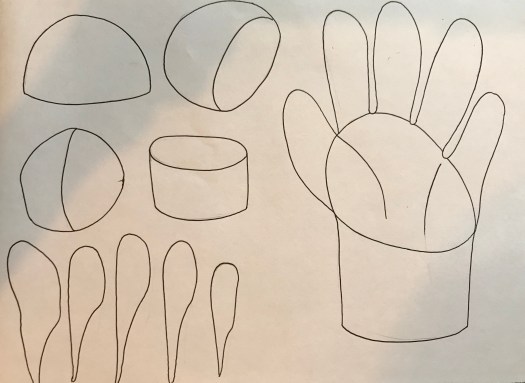
During this workshop we where shown how to construct a hand from a pinch pot technique. this evolved joining two pinch pots together to create a hollow ‘palm of the hand’, then using this to attach the wrist, fingers and add details. This was an interesting technique to use but a very simple and effective method, and it was helpful having your own hand available for reference. IMG_2164

I created this template as a rough guide so I will be able to recreate this construction again.

fullsizeoutput_3b3.jpeg

GROUP SLAD BUILDING WORKSHOP

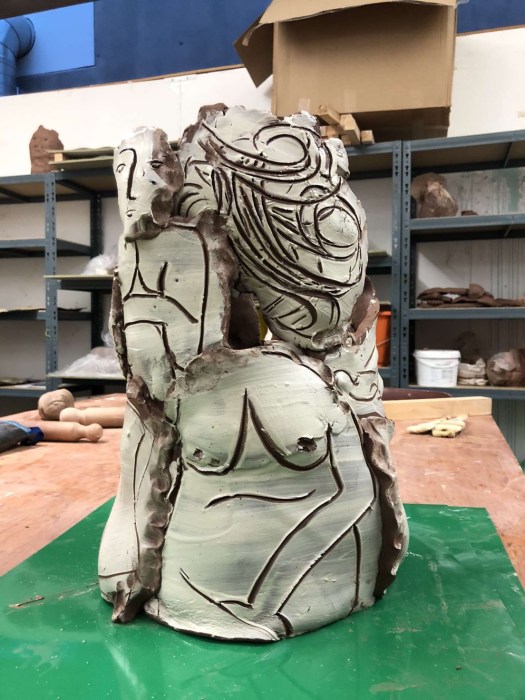
This workshop explored the figure through using our  life drawing studies to inspire and influence shapes and key areas of focus within the form. this technique involved rolling out slabs, applying a slip to the surface and then craving out the features using tools, to emphasise the shapes of the body and make our constructions more three dimensional we pushed out the clay from the other side. this was an interesting experiment as it made me more aware of how much you can push and pull clay to withstand its own weight.

IMG_2244

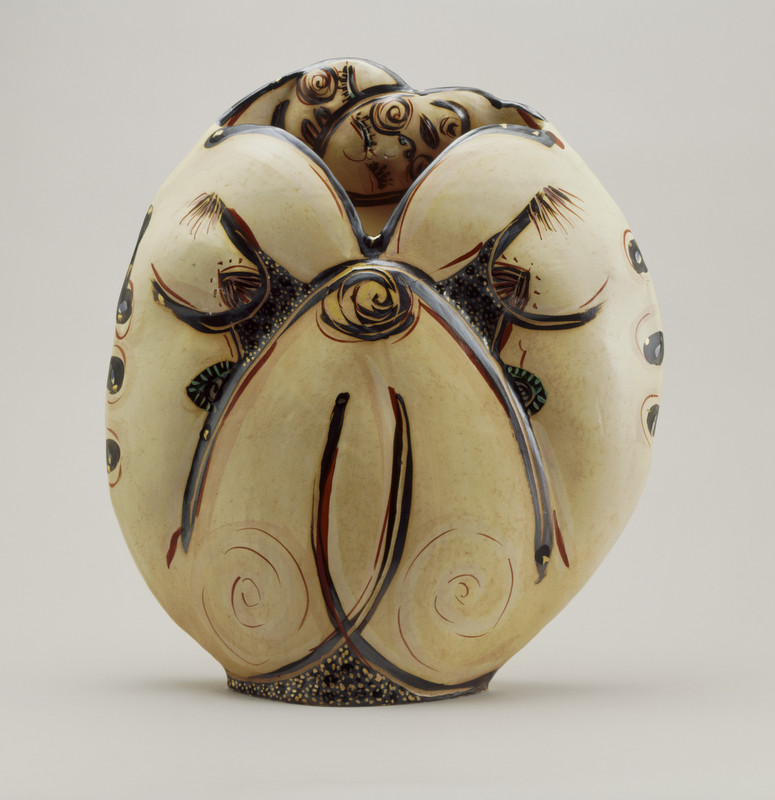
During my trip to the V and A I found the artist Akio Takamori, who creates figurative pieces using a similar slab building technique.

Aiko Takamori vase

 Thom, D. and Thom, D. (2019). Out On Display #4: Akio Takamori and ‘Queer Objects’ • V&A Blog. [online] V&A Blog. Available at: https://www.vam.ac.uk/blog/museum-life/out-on-display-4-akio-takamori-and-queer-objects [Accessed 9 Dec. 2019].

LIFE DRAWING ACTIVITIES

The life drawing sessions opened up my understanding of drawing and helped me identify how to communicate tension, strain, shadow and proportional understanding. these fast paced drawing sessions focused my mind on seeing the lines and shapes of the body as well as using time pressures to pick up key information.

We were challenge to hold a pose like the model, this was only when I realised where I should be focusing my drawing and creating darkness and shadow to communicate the feelings and straigns felt by the model, doing this made me feel empathy for the model and I feel I was then able to communicate this better in my work.

BEFORE the pose activity

AFTER the pose activity

there is quite a defined difference seen between the two, having to understand the pose and the way the body feels different pressures encouraged me to create tonal changes in my work, in order to understand, communicate and appreciate the figure

We were encouraged to use alternative mediums, by previously looking at the work of Alberto Giacometti, I was keen to emulate a similar characteristic in my work, therefore using pen I focused in creating darkened areas of focus (where I thought the models tension would be) as well as imagining the skin and muscular tensions and I feel this emphasis on the shapes creates a really interesting understanding of the movement within the figure.

Doing these life drawing sessions changed my perceptions and making skills during the workshops as I developed a better understanding of the body as a dynamic build up of shape and line
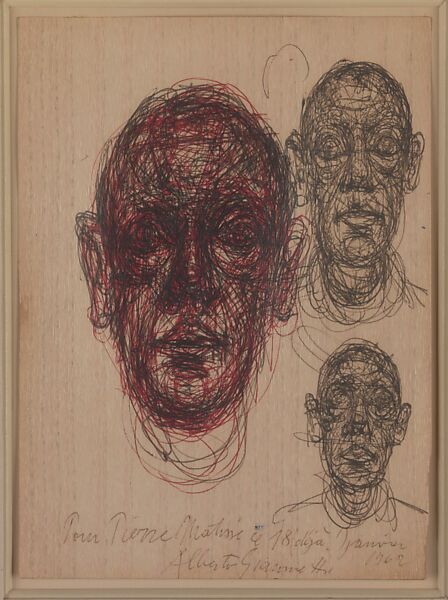
Image result for alberto giacometti drawings

Metmuseum.org. (2019). [online] Available at: https://www.metmuseum.org/art/collection/search/492775 [Accessed 8 Dec. 2019].

IMG_2261

Looking further into the work of Giacometti, I have discovered his sculptures, he works in the style of Cubism and Surrealism, creating elongated sculptures that are formed from memory creating these inaccurate elongated and shrunk representations of the figure,

Alberto Giacometti, Pointing Man (L’homme au doigt). (Courtesy Christie's)

Freeman, N. (2019). A Life-Size Giacometti Could Be Priciest Sculpture Auctioned in History of Sculpture. [online] Observer. Available at: https://observer.com/2015/04/a-life-size-giacometti-could-be-priciest-scupture-auctioned-in-history-of-sculpture/ [Accessed 8 Dec. 2019].
 

NATASHAS LECTURE: FIGURATIVE CERAMICS

Representation and expression can be used as a way of understanding the reasons why the artist may have created the work,

The artist that interested my greatly during this lecture was Ron Muek “dead dad”- his work identifies the recognisable body form but plays with scale to create conflicting ideas and representations that create a confusing debate where the mind wants to imagine a full scale man but what is shown is a small scale mini man. This therefore represents a realistic body in characteristics yet not a realic body in scale.Ron Mueck, Dead Dad, 1996Withreferencetodeath.philippocock.net. (2019). Mueck, Ron – Dead Dad 1996 – with reference to death. [online] Available at: http://withreferencetodeath.philippocock.net/blog/mueck-ron-dead-dad-1996/ [Accessed 8 Dec. 2019].

Bonnie kemske also interested me as an espressional artist “cast hugs”, due to the use to tactility, touch and sensitivity as a result of a hand held huggable form that encourages the viewer to embrace the ceramic forms as a way of forming a connection to usually touch deprived figure sculptures, these sculptures express a representation of the figure without it having a body nor a face.

Bonniekemske.com. (2019). [online] Available at: https://www.bonniekemske.com/cast-hugs [Accessed 8 Dec. 2019].

MEDAL PROCESS: MAKING THE MOULD AND CASTING IN WAX

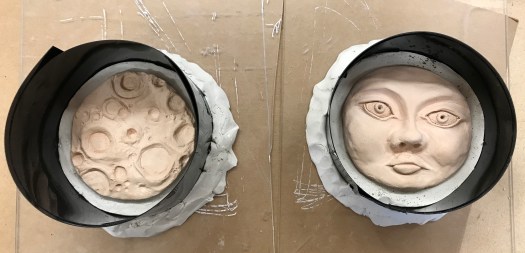
Using plasticine I fixed my forms to the board reinforcing the edges with plastic and tape to form the area for the silicone mould. after mixing the ingredients, I poured it into the moulds and released as many of the air bubbles I could as this affects the detailed, i let the moulds set overnight.

LESSON LEARNED! use a release agent on the ceramics before covering in silicone, when taking these from the mould the silicone stuck to the forms and I lost a lot of details that I will have to rebuild using wax.

fullsizeoutput_3b0

Using these moulds I then melted green wax and cast the forms. As I made these as two separate forms I then had to melt the two halves together in order to make the medal whole. I am pleased with the overall outcome. I now have to wait until my group is all at the same stage so that we can progress onto the ceramic tree stage of the bronze process.

SCULPTING A FOOT

Learning from the history of figurative
Considering children, ageing, damage and inside out, figurative art has many connotations and throws up many uneasy feelings and emits emotions that makes you consider the figure within different variants to contrast qualities obtained through the skin for example, creating these aspects in relation to the influence using clay as an inanimate object. what techniques can be used to speak about the qualities of the body. Considering representation, artists use this to portray a quality within the work that is recognisable qualities of a figure to express, exaggerate, gesture and highlight. where as expression is used within works of art to play around with this recognisable quality, these outcomes tend to be symbolic, non human, non representational and creepy in some circumstances, this addresses the sense of recognition, hinting towards the known and unknown the comfortable, and the uncomfortable.

Making a foot from a single piece of clay
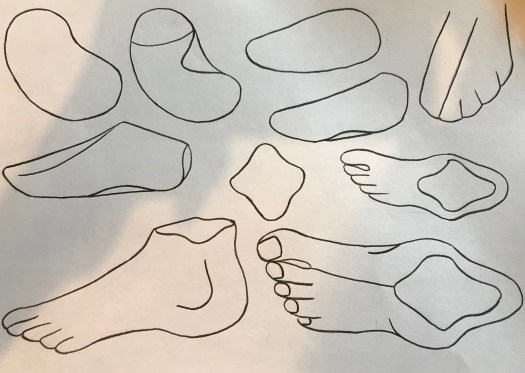
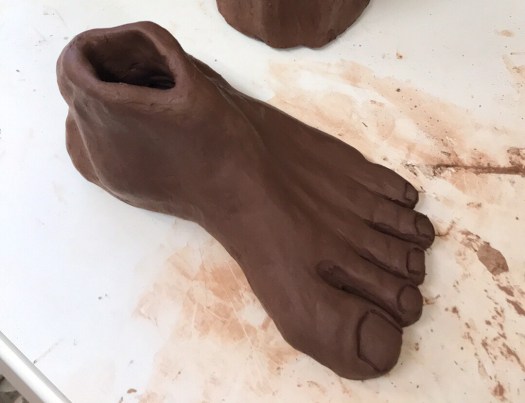
we started with using a single piece of clay to form the heel and curvature of the sole (from the palm of my hand), ankle and toes being aware of the sharpness of angles from the toe to the flatter little toes,as well as the formation of the diamond on the top of the ankle, shaping and smoothing as I went on. As it started taking shape I began to refine the shape of the toes and hollow the middle of the foot, I enjoyed using this technique and will continue to adhere these skills and practice making and refining more.

fullsizeoutput_3b2


I created this template so that I could recreate this process again, this is a very simple way of making a foot in the round, I very much enjoyed this workshop.

working back into the foot

img_2192.jpg


INTRODUCTION TO THE FIGURATIVE FIELD

Introduction to the project and initially exploring figurative artists
As a group discussion we explored what the works show, how the surface explores it and the setting the work has been presented in and how that can influence the audience. considering the skills, context and approach. (Approach being the most important of the three; ways of doing, thinking, finding, building and presenting.)

It was interesting to compare and contrast how different artists approach the figure and the variations of feeling that come from the work created by the use of different mediums, through expression and representation

Life drawing
This session gave me a greater appreciation for line and alining my eye with my hand enabled me to gather information from the model to inform a fast pace drawing that captured the important and dominant lines of the body. I enjoyed this session as I am very out of practice with life drawing and it is a really important skill to develop. I can see how doing this can inform the way I use construct and use clay as a way of representing the figure considering the surface, structure and expression. I used charcoal for these sketches.


Design a site like this with WordPress.com
Get started